 Exhibition
 B2B Platforms
 Standalone Website
 Social Media
 Emails
Tendata Joins Wu Xiaobo Channel and China Business Overseas Industry Alliance to Launch the "2026 North Africa Going‑Global Special Report"!
 Events
 2026-08-24
Before coming to North Africa, many people assumed this region was just hot, poor, and chaotic. Only after setting foot on this land did it hit me:
Many of us have been using a single frame called "Africa" to describe over 50 completely different countries. The market logic differs, the risks differ, and the opportunities differ.
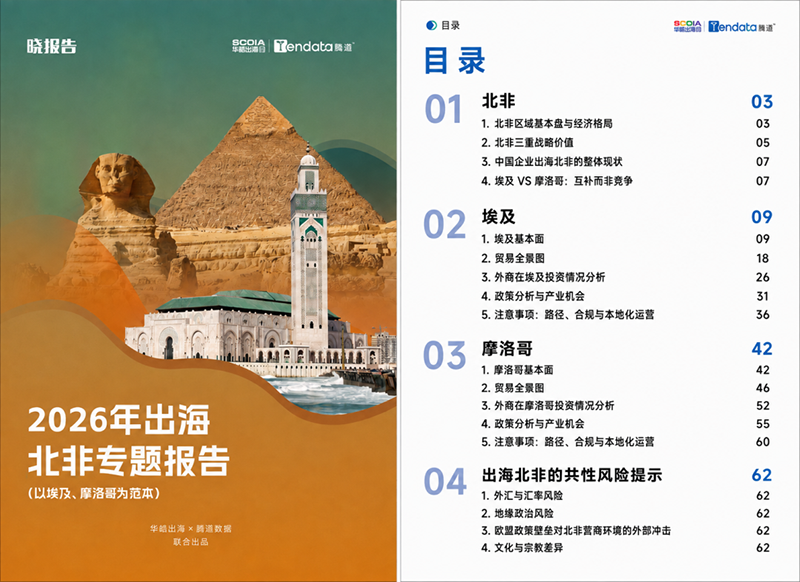
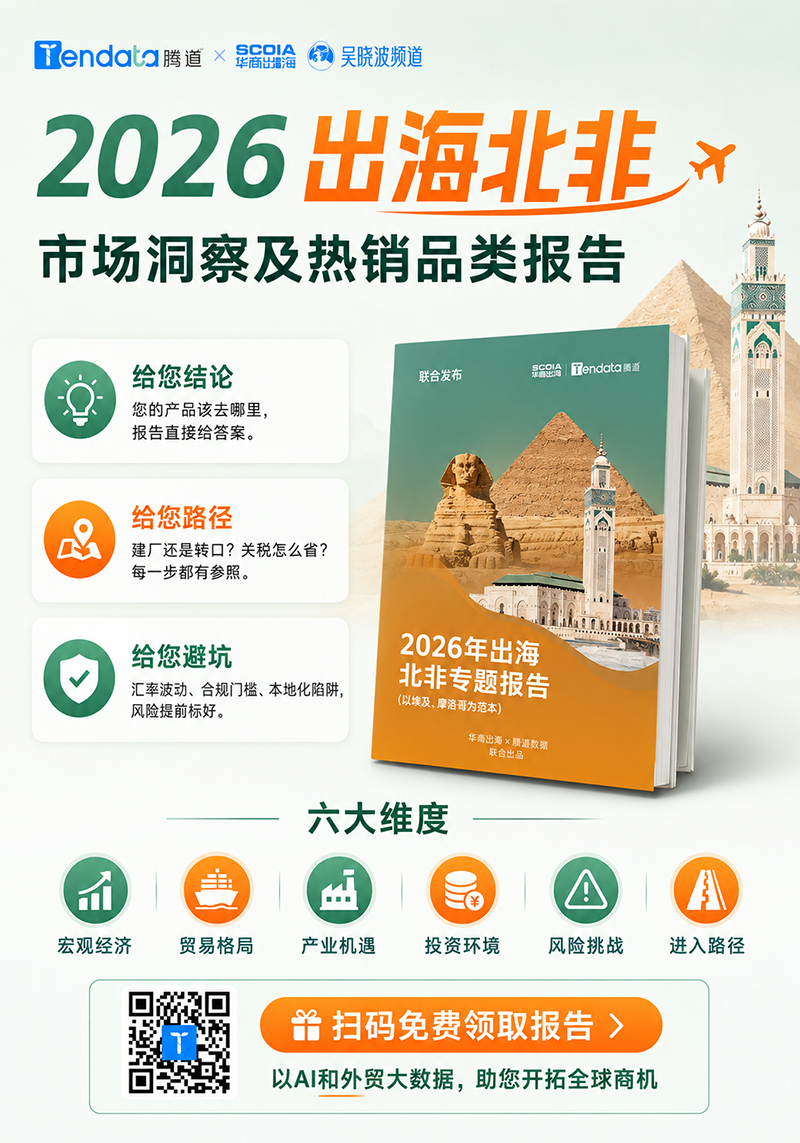
Tendata, together with Wu Xiaobo Channel and Huashang Overseas Industry Alliance, has jointly released the2026 North Africa Expansion Report(with Egypt and Morocco as case studies). Covering market value, industry opportunities, risks, and challenges, it provides globalizing enterprises with comprehensive decision-making references and a practical guide.>>Get the free report
01 North Africa Is Being Set Alight by the Chinese
North Africa is becoming the new hotspot for Chinese enterprises going global.
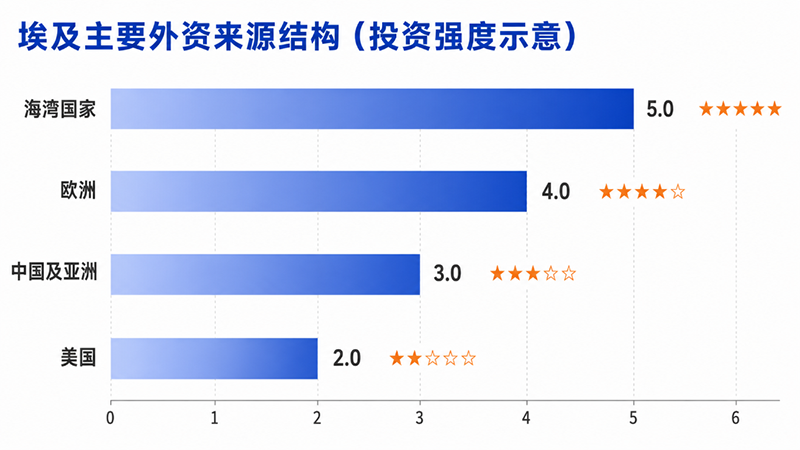
In 2025, China's existing investment in Egypt reached US$10 billion.According to the Egyptian Federation of Chambers of Commerce, there are now 3,368 companies with Chinese capital, a 2-3x increase over the past two years. In the past year alone, Egypt added over 300 new Chinese-invested enterprises. In five years, China's ranking among Egypt's sources of FDI jumped from 22nd to 12th.
Morocco is equally booming. As of March 2026, the Tangier Tech City had signed 34 Chinese enterprises with a projected total investment of approximately US$3.5 billion. Chinese enterprises' intended investment in Morocco has exceeded US$10 billion. Within a single year, the number of Chinese nationals in Morocco grew from 3,000 to about 20,000.>>Get the free report
Why North Africa?
The most fundamental reason istariffs. Flooring made in China faces a 130% tariff when exported to the US and a 28% anti-dumping duty to the EU. Produced in Egypt, the maximum tariff for US exports is just 10%. Morocco enjoys zero tariffs to the EU and 0-10% to the US. Against the backdrop of rising trade barriers, North Africa has become a rare"tariff lowland."
But that lowland is narrowing. Starting July 24, the US imposed new Section 301 tariffs on 60 countries and regions — Egypt's effective rate will rise to 13.8%, and Morocco's from 9.9% to 11.4%.
The tariff advantage isn't what it used to be, but compared to exporting directly from China, North Africa remains the better option.Egypt, with 118 million people, andMorocco, holding free trade agreements with 56 countries, are upgrading from a "tariff lowland" to an "industrial relocation destination."
Another key shift:localization is turning from slogan into hard requirement.Egypt mandates a 35% local production rate; Morocco requires 40%. Going overseas is no longer about "moving factories" — it's about "putting down roots."
North Africa's GDP growth for 2026 is projected at 4.2%, higher than the rest of Africa and the global average. Egypt and Morocco each anchor one end, together forming the"twin anchors"for Chinese enterprises entering North Africa.>>Get the free report
02 Egypt: The Math of 118 Million People Must Add Up
What's most compelling about Egypt is simply itspeople.
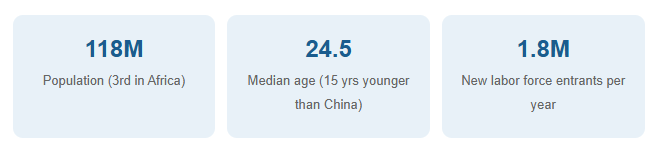
Manufacturing wages run US$200-300 per month — roughly RMB 1,000 per worker. More than 1.8 million new entrants flood into the labor market every year.
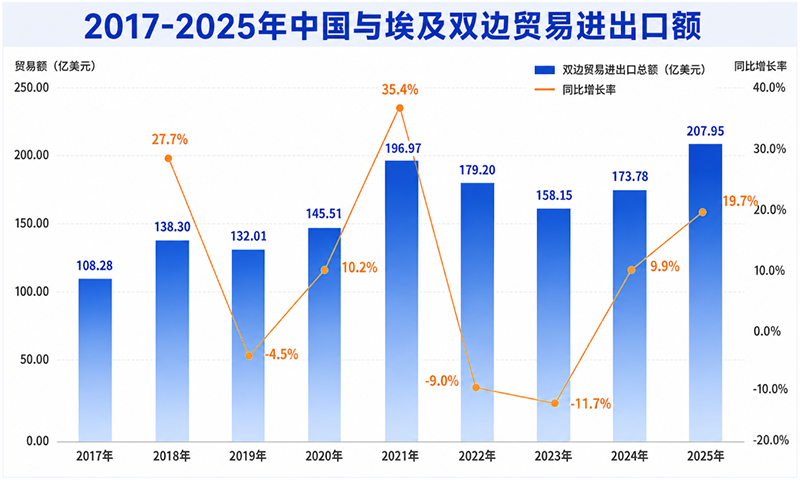
In 2025, China-Egypt bilateral trade reachedUS$20.795 billion, a historic high, with China remaining Egypt's largest trading partner for consecutive years. But the trade surplus stands at US$19.153 billion — a severely imbalanced structure. Egypt sells resource-based products and agricultural goods to the Gulf and Europe, while buying industrial goods from China.>>Learn about import/export data
Opportunities concentrate in three directions:
- Home Appliances & Consumer ElectronicsThe fastest to land — local brands are weak and supply gaps are significant. Haier built a US$185 million industrial park in Egypt with capacity exceeding 1.5 million units, climbing to No.3 in local market share — that speed tells you how empty the market is.
- Automobiles & PartsUS$8.066 billion in imports and exports in 2025. The opportunity lies in the triple stack of "vehicle assembly + KD kits + local supply chain."
- Digital Infrastructure87.42 million internet users, ICT industry growing at double digits for five straight years — young population, high smartphone penetration, but digital infrastructure still in its infancy.
"If you can't compete in China anymore, go look at Egypt. 118 million people, most of whom still can't afford air conditioning — but the heat is unbearable. By the time they can afford it, your factory will already be built there."— A home appliance industry practitioner
In Sadat City, one of Egypt's major industrial hubs, a Taizhou business owner running a brass hardware manufacturing operation generates RMB 300 million a year — with margins 20% higher than back home.
A 72-year-old transformer manufacturer from Foshan, hair already gray, still intends to expand to Egypt. The head of the TEDA Zone says he receives 300-400 delegations a year — what used to take six or seven years from inspection to landing now takes just one or two.
Egypt has one more card:the Suez Canal. The TEDA Zone is just 7 kilometers from the canal's port, with cargo loaded and shipped within 48 hours. In May 2026, the zone's Phase III expansion was just completed.
But do the full math before you move. Egypt suffers severe wealth polarization; the Egyptian pound continues to depreciate, losing about 5% annually. Suez Canal revenue fell from US$10.2 billion in 2023 to US$4 billion in 2024.
Egypt is North Africa's biggest market opportunity — and its most macro-economically complex.
03 Morocco: Europe, Just 14 Kilometers Away
Flying 5 hours from Egypt to Morocco feels like stepping into Europe.
Morocco was a French colony, and French remains widely spoken. The Mediterranean climate stays in the twenties year-round, houses painted in vivid colors — standing at the Port of Tangier, you can see Spain across the water:14 kilometers, closer than Shanghai to Hangzhou.
Morocco holdsfree trade agreements covering 56 countries, giving its products tariff-free access to European and American markets. With the EU imposing tariffs of up to 37.6% on Chinese EVs, Morocco has become the most compliant alternative.
Morocco has another card:phosphate. Seventy percent of the world's proven reserves sit here — roughly 50 billion tons. Once this chain runs through, it becomes: phosphate → lithium iron phosphate cathode material → EV batteries → the European EV market.
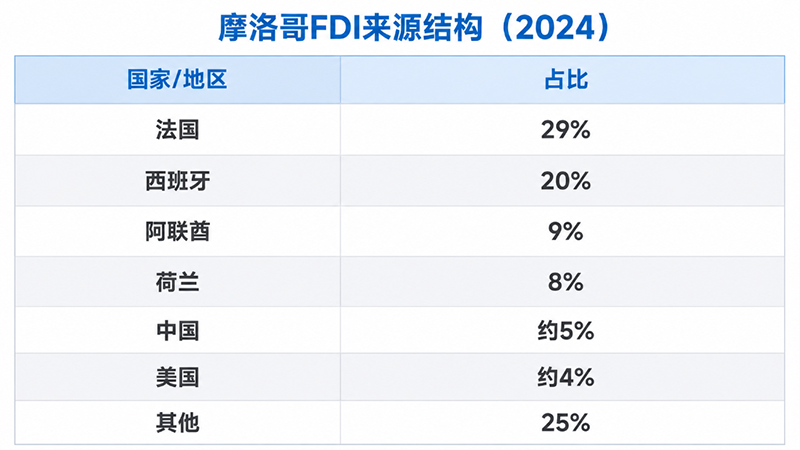
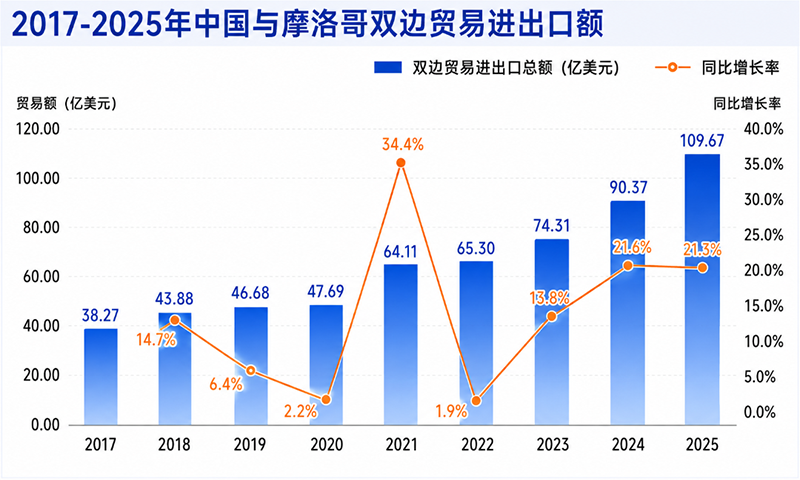
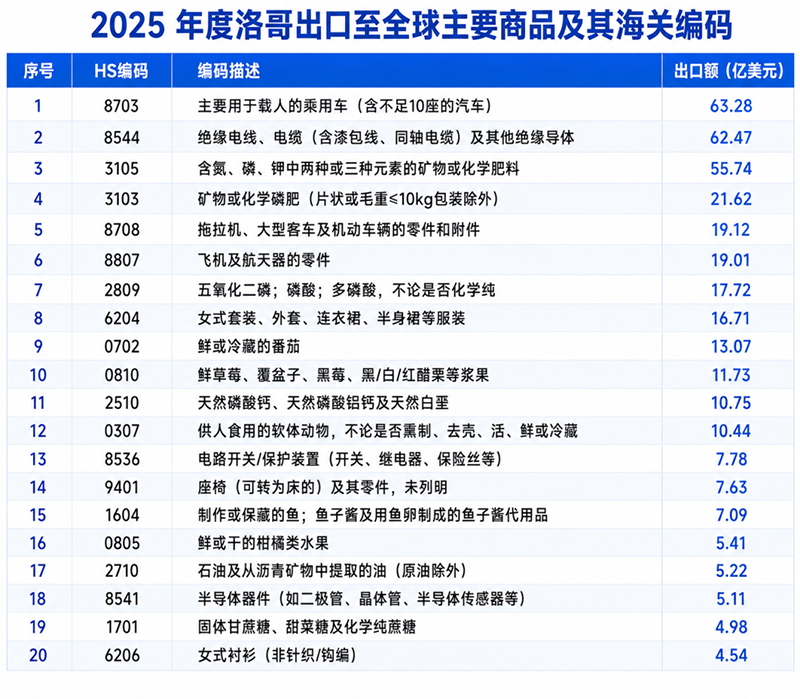
China is a key trading partner of Morocco. According to Tendata data, 2025 China-Morocco bilateral trade reachedUS$10.967 billion, another historic high. China is Morocco's 5th largest source of FDI, investing US$210 million.>>Learn about import/export data
Chinese enterprises are laying out in clusters:
- Gotion High-TechInvested US$1.3 billion in an EV battery plant, with the government granting it a dedicated bonded zone.
- BTR New MaterialBuilt a 50,000-ton cathode material project in Tangier Tech City.
- Tangier Tech CityAs of March 2026, 34 Chinese enterprises signed, with projected total investment of about US$3.5 billion.
The auto industry is racing ahead too. Morocco's vehicle production broke1 million unitsin 2025 — surpassing South Africa to become Africa's largest automobile producer. CITIC Dicastal built Africa's first "Lighthouse Factory."
But Morocco's risk isn't chaos — it'stight coupling. Nearly 65% of its exports go to Europe, and in the Tangier region, that figure reaches 80%. The carbon border tax began collecting in 2026, at €60-100 per ton. Sometimes your fate isn't in your own hands — it sits in meeting rooms in Brussels and Washington.
Morocco is North Africa's most stable economy — and the most exposed to European policy shifts.
North Africa Isn't One "Market"
It's two businesses stacked together.
EgyptandMorocco— one guards the Suez and faces Africa, the other looks across the sea at Europe backed by phosphate reserves — form the two pivots of North Africa. Each market has its own logic.
The 2026 North Africa Expansion Report, jointly released by Tendata, Wu Xiaobo Channel, and Huashang Overseas Industry Alliance, lays out the expansion paths for both markets — not vague talk about opportunities, but line-item accounting of tariffs, exchange rates, localization rates, and industrial landing conditions.>>Learn about import/export data
Tendata · Wu Xiaobo Channel · Huashang Overseas Industry Alliance
Opening New Insights for Enterprise Globalization
This is more than co-created content — it's a strong endorsement of Tendata's authority in foreign trade big data and business research.
Define Trends with Data. Drive Decisions with Insight.
Why Tendata?
In an age of information overload, what's truly scarce ishigh-quality, structured, actionable business intelligence.
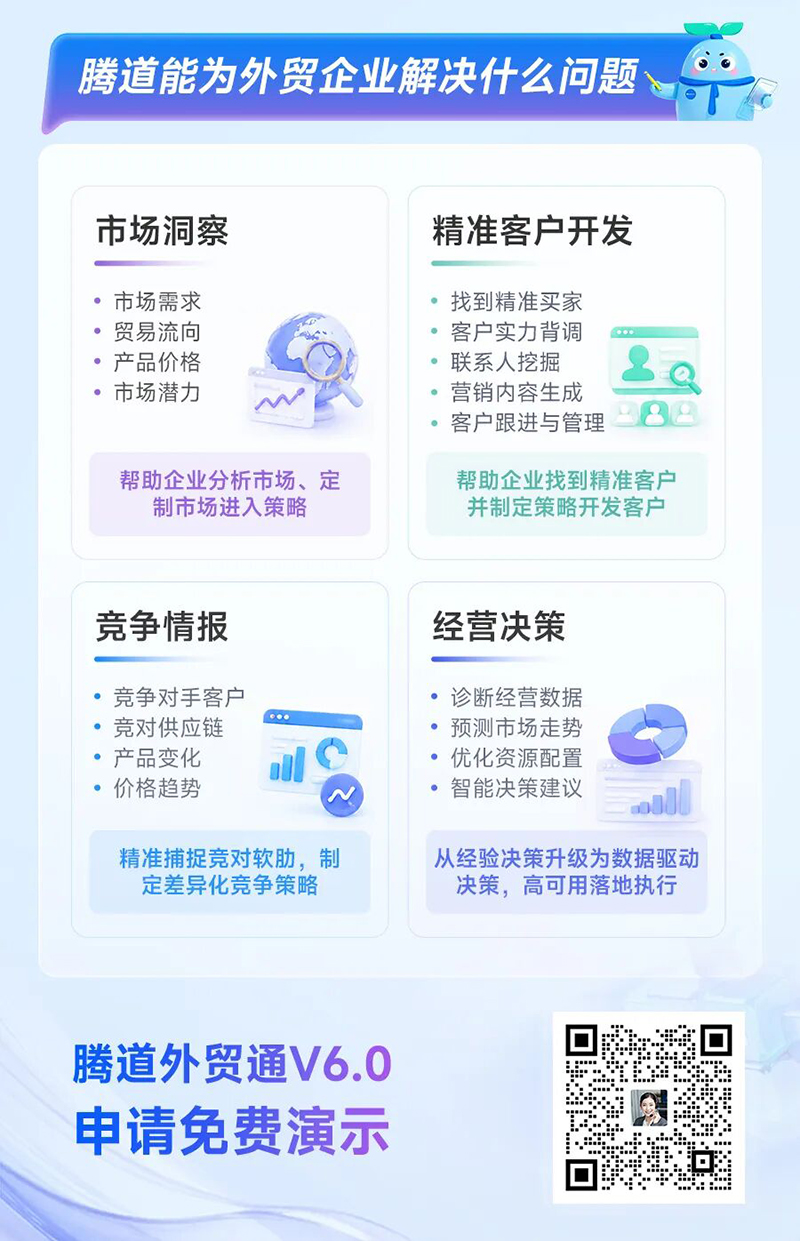
As a foreign trade vertical AI + big data solution provider, Tendata brings three core capabilities:
- 1Data Foundation20 years of accumulation, covering hundreds of millions of enterprises and tens of billions of transactions — with granularity down to the individual record.
- 2AI EngineA proprietary foreign trade vertical large model — real-time tracking, intelligent inference, precise recommendations.
- 3Industry DepthValidated by 100,000+ clients in the field. We understand data — and the foreign trade scenario — delivering executable strategy.
Overseas Decisions: See Clearly · Move Steadily · Win Decisively
Category
Leave Message for Demo Request or Questions