
 Exhibition
 B2B Platforms
 Standalone Website
 Social Media
 Emails
Top Gravel Exporting Countries & Companies in 2025 - Tendata
 Export News
 2026-10-10
Global gravel exports were valued at US$2.92 billion in 2025, marking a decline over the past five years. Compared with 2021, when worldwide gravel exports totaled US$3.34 billion, export value decreased by 12.8%.
The downward trend continued in the latest year, with international gravel export revenue falling by 8.3% from US$3.18 billion in 2024.
Gravel consists of loose rock fragments classified according to particle size. It is an important raw material for construction and infrastructure projects, particularly for surfacing roads in rural areas and locations with relatively light traffic.
Beyond road construction, gravel is often mixed with sand for use in asphalt and other building materials. It also serves as an aggregate or filler in products such as concrete blocks, bricks, and pipes. Additional applications include roofing shingles, water filtration systems, and improving traction on icy roads during winter. When combined with industrial sand, gravel-related materials can also be used in glass production.
The five largest gravel-exporting countries by value in 2025 were Norway, Germany, mainland China, Belgium, and France. Together, these markets accounted for 39.6% of global gravel export revenue.
Their combined share highlights the importance of European suppliers in the international gravel trade, alongside major exporters in Asia and North America.
Gravel Exports by Continent
Europe was the leading regional source of exported gravel in 2025. Shipments from European countries reached US$1.9 billion, representing 65.6% of worldwide export value.
Asia ranked second, contributing 22.5% of global gravel exports, while North America accounted for another 9.5%.
The remaining export shares were distributed across smaller regions:
· Latin America: 1.7%, excluding Mexico but including the Caribbean
· Africa: 0.5%
· Oceania: 0.2%, led by New Zealand, Fiji, and Australia
These regional figures underline Europe's dominant position in global gravel exports, with Asian and North American suppliers accounting for most of the remaining trade value.
For international trade research, the relevant four-digit Harmonized System heading is HS 2517, which covers pebbles, gravel, and broken or crushed stone used for aggregate and related applications.
Using the appropriate HS classification helps businesses investigate gravel shipments, compare exporting markets, and research cross-border trade in construction materials. Importers and exporters can also use trade data to evaluate supplier markets and identify potential commercial partners.
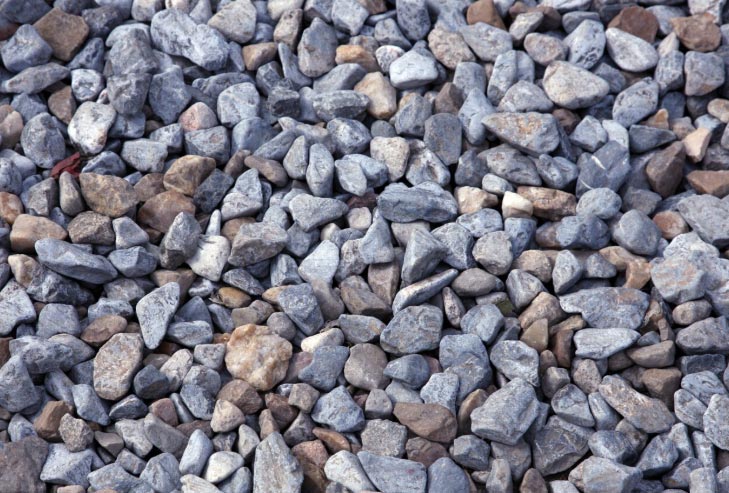
Top 15 Gravel Exporting Countries in 2025
The following list ranks the 15 countries with the highest gravel export values in 2025.
1. Norway: US$316.6 million (10.9% of global gravel exports)
2. Germany: US$273.3 million (9.4%)
3. Mainland China: US$234.4 million (8%)
4. Belgium: US$165.7 million (5.7%)
5. France: US$163.2 million (5.6%)
6. Canada: US$157.4 million (5.4%)
7. Austria: US$135.3 million (4.6%)
8. Netherlands: US$116.1 million (4%)
9. Croatia: US$88.7 million (3%)
10. United Kingdom: US$88.7 million (3%)
11. Italy: US$74.6 million (2.6%)
12. United States: US$71.2 million (2.4%)
13. Oman: US$68.9 million (2.4%)
14. India: US$65.3 million (2.2%)
15. Indonesia: US$65 million (2.2%)
Collectively, these 15 countries accounted for 71.5% of global gravel exports by value in 2025, demonstrating that international supply was concentrated among a relatively limited group of exporting markets.
Norway ranked first, followed by Germany and mainland China. Belgium and France also held prominent positions, while Canada and Austria contributed substantial export value.
Fastest-Growing Gravel Exporters
Several major gravel-exporting countries recorded increases in export value between 2024 and 2025. The strongest growth rates among the listed exporters were:
· United States: up 45.1%
· Indonesia: up 17.3%
· Canada: up 15.3%
· Oman: up 13.1%
These gains point to stronger export activity in several markets and may provide useful signals for businesses monitoring changes in international construction-materials trade.
Gravel Exporters with Declining Sales
In contrast, some leading suppliers experienced year-over-year declines in gravel export value:
· India: down 14.6%
· Mainland China: down 9.8%
· Italy: down 0.7%
Tracking both growing and declining exporters can help businesses assess changes in supplier performance and compare market conditions when evaluating international sourcing opportunities.
Gravel Exporting Companies Identified by Tendata
According to Tendata, the following companies are examples of businesses appearing in the supplied gravel-trade data. The reported shares and values are reproduced below.
>>View More Suppliers in Tendata
1. TOYOTA MOTOR CORPORATION — 4.78%, US$65.34 million
2. BMW AG WERK MUENCHEN W 1 1 — 3.47%, US$47.44 million
3. PFIZER SERVICE CO ELC — 2.87%, US$39.29 million
4. MITSUBISHI MOTORS CORPORATION — 2.7%, US$36.99 million
5. SANOFI WINTHROP INDUSTRIE SA — 2.67%, US$36.51 million
6. ASTRAZENECA A B — 2.58%, US$35.22 million
7. NISSAN MEXICANA S A DE C V — 2.55%, US$34.84 million
8. CORTEVA AGRISCIENCE INTERNATIONAL SARL — 2.38%, US$32.59 million
9. FCA INTERNATIONAL OPERATIONS LLC — 1.95%, US$26.72 million
10. Tianjin Mobis Automotive Parts Co., Ltd. — 1.84%, US$25.22 million
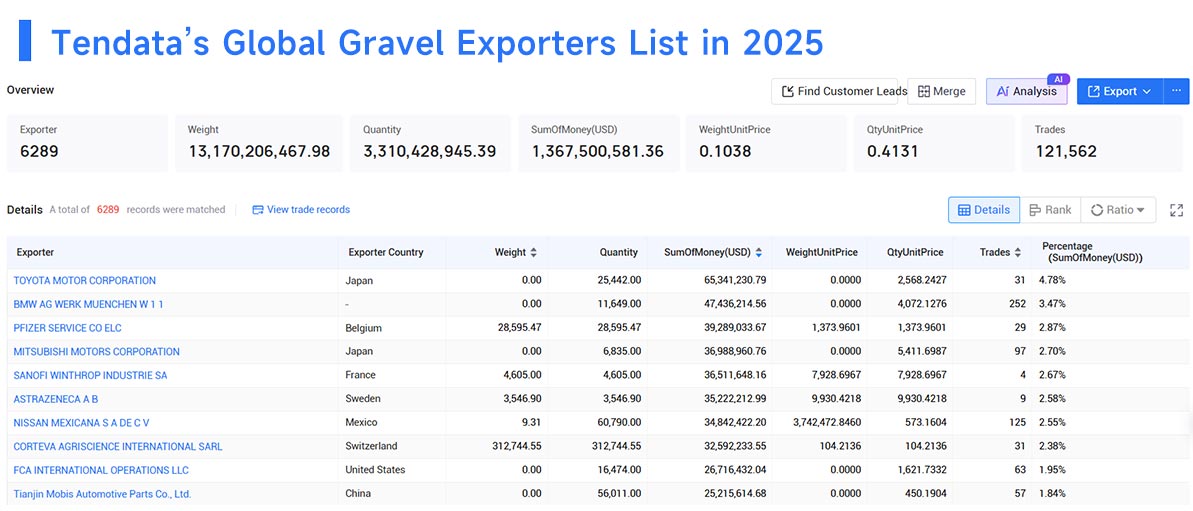
Company-level trade records can offer additional detail beyond country-level export statistics. Businesses researching gravel suppliers should verify each company's product specialization and confirm that the underlying shipment records relate to gravel or products covered by the relevant HS classification.
Country-level export data helps businesses understand the geographic distribution of gravel supply, identify major exporting markets, and monitor changes in international trade value.
Tendata's global trade data platform helps importers, exporters, and sales teams research shipment records, analyze company trading activity, and investigate potential business partners. By combining product-level trade statistics with company-level intelligence, businesses can develop a more targeted approach to supplier research and international market analysis.
For companies operating in construction materials and infrastructure supply chains, global trade data can provide a useful starting point for evaluating export markets, comparing suppliers, and identifying potential trading relationships.`
Category
Leave Message for Demo Request or Questions