
 Exhibition
 B2B Platforms
 Standalone Website
 Social Media
 Emails
How International Trade Data Drives Real Business Results - Tendata
 Market Insights
 2026-08-17
International trade data is often used to understand where products are moving and how markets are changing. But for companies doing business across borders, its value goes much further. The right data can help identify new markets, understand competitors, find potential customers, and make better decisions about products and pricing.
For manufacturers, exporters, and trading companies, the challenge is turning large amounts of trade information into something useful for day-to-day business development. This is where international trade data can make a practical difference.
Instead of relying entirely on market experience or broad customer outreach, companies can use actual trade activity to understand what is happening in their target markets and adjust their strategies accordingly.

What International Trade Data Can Reveal
International trade data contains information about the movement of products between countries and regions. Depending on the data source, businesses may be able to analyze products, HS codes, import and export values, quantities, countries, buyers, suppliers, and historical trade activities.
This information can answer questions that are difficult to solve through traditional market research.
- Where is demand increasing?
- Which countries are importing more of a particular product?
- Who are the major suppliers?
- Which companies are actively purchasing?
- How are competitors changing their market strategies?
- Are existing customers increasing or reducing their purchasing activity?
When these signals are analyzed together, businesses can make more informed decisions about market expansion and customer development.
Why Companies Need More Than Basic Trade Statistics
Public trade statistics are useful for understanding the overall market, but aggregated numbers do not always explain what is happening at the company level.
For example, a country may show strong import growth for a certain chemical product. That tells an exporter that demand exists, but it does not necessarily identify the companies behind that demand.
A company entering a new market may need to know which buyers are active, what products they purchase, who their suppliers are, and how their purchasing behavior has changed. This is where a more detailed approach to international trade data becomes valuable.
Tendatacombines trade information with business data, customer intelligence, competitor analysis, and other data sources to help companies move from market-level research to more specific business decisions.
The following customer cases show how companies have used this approach in different industries.
Three Businesses Using International Trade Data to Improve Growth
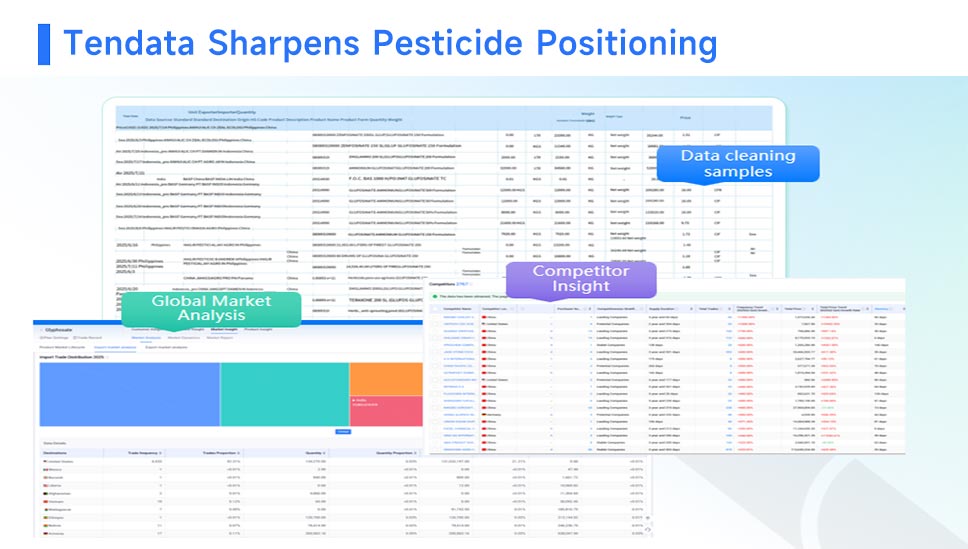
Case 1: Using Trade Data to Strengthen Positioning in the Pesticide Market
One customer, ADAMA Ltd., operates in the crop protection industry and provides a wide range of products for agricultural applications, with more than 270 active ingredients and over 1,000 end products. The company was facing several challenges in a highly competitive market.
Global pesticide protection demand was becoming more fragmented, while pricing pressure was affecting sales performance. At the same time, different markets presented different challenges, making it difficult to rely on a single market strategy.
Tendata helped the company use trade data to gain a clearer view of the market. By analyzing market activity and competitor information, the company could better understand market demand, identify changes in purchasing behavior, and compare competitive activity across different markets. The data also helped the team evaluate market opportunities and formulate more targeted pricing and product strategies.The result was a 30% increase in the competitiveness of its pesticide market.
For companies operating in competitive industries, this case shows how international trade data can support decisions beyond simple market sizing. When trade activity is combined with competitor information and market analysis, companies can develop strategies based on what is actually happening in the market.
>>> Get a Free Demo from Tendata <<<
Case 2: Opening 10 New Markets in Six Months
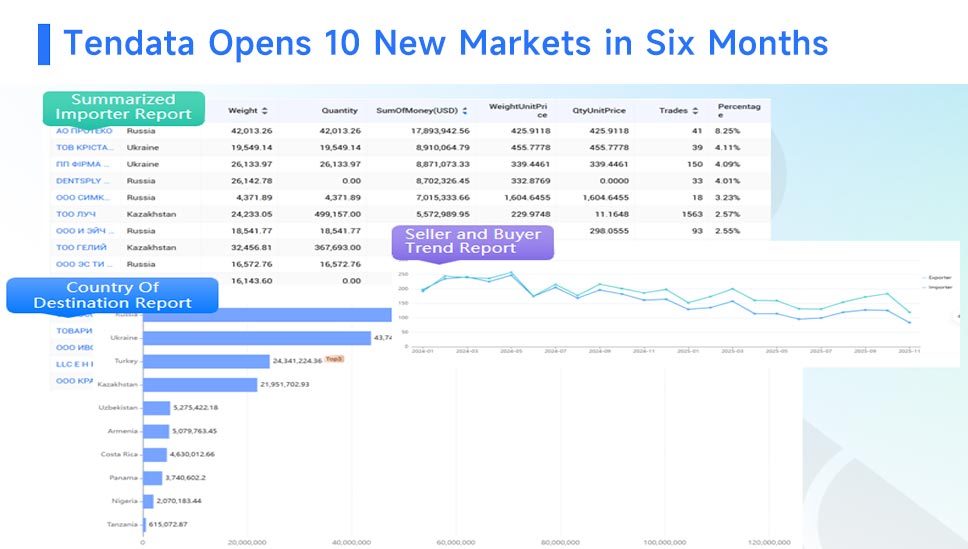
Another customer, Toray International (China) Co., Ltd., is engaged in trading and trade consulting services across a broad range of products and industries. One of its major challenges was identifying suitable markets for new business opportunities. The company lacked an efficient way to determine which markets were worth entering, while market analysis and data collection required significant time and effort. It also did not have a dedicated team to produce detailed market analysis reports.
Tendata helped the company analyze global trade activity in real time and identify potential markets based on actual import and export trends. The team could use summarized import and export information, country-level destination analysis, and other trade indicators to compare markets and identify promising opportunities. Customer service resources were also used to support data cleaning and analysis, making the research process more efficient. Instead of spending large amounts of time manually collecting information, the company could use Tendata to quickly evaluate different markets and identify where demand and business potential were stronger.
With the help of these digital tools, the company successfully opened 10 new markets within six months.
This case demonstrates an important role of international trade data in market expansion. Businesses do not necessarily need to enter every market they can find. The goal is to identify markets with sufficient demand and then prioritize those with stronger commercial potential.
>>> Get a Free Demo from Tendata <<<
Case 3: Data-Driven Customer Development Increased Growth by 40%
The third case involved Bailing Technology Co., Ltd., a company engaged in the production and sales of fine chemicals, including fluorine-containing products, lubricants, and other related materials.
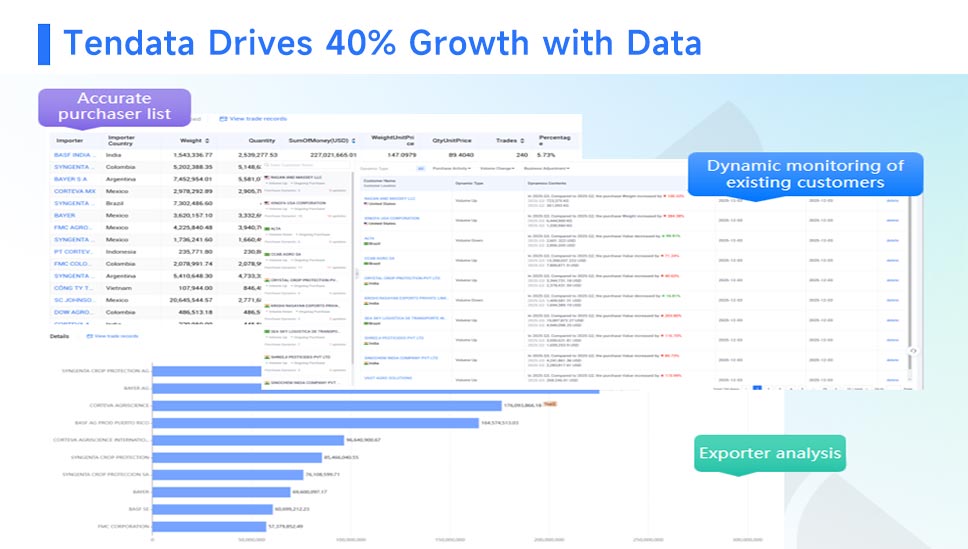
The company had several challenges in customer development. Without knowing which prospects were actively purchasing its products, sales teams could spend considerable time reaching out to companies with limited potential. The company also lacked sufficient insight into competitors' supply chains and purchasing relationships. At the same time, maintaining existing customers and identifying new purchasing opportunities required continuous monitoring.
Tendata helped the company analyze purchasing behavior and identify more relevant prospects. Through trade data analysis, the company could identify potential buyers based on actual purchasing activity rather than relying only on general company information. Tendata also helped analyze competitor supply chains and purchasing relationships, giving the company additional insight into potential business opportunities. Another important part of the solution was customer monitoring. By tracking changes in existing customers' purchasing activities, the company could identify new signals and respond to potential opportunities more quickly.
As a result, customer growth increased by 40%.
This case highlights another practical use of international trade data. Trade information is not only useful before entering a market. It can also support ongoing customer acquisition, competitor analysis, and account development.
>>> Get a Free Demo from Tendata <<<
What These Three Cases Have in Common
Although the three companies operate in different industries, their challenges were quite similar.
They needed to make better decisions about where to sell, who to target, and how to respond to market changes.
The first company used trade and competitor intelligence to strengthen its market strategy.
The second used trade data to identify and enter new markets.
The third used purchasing and competitor information to improve customer development.
These different applications show that international trade data can support multiple stages of international business.
Market Research
Companies can compare countries, products, import volumes, and trade trends to identify markets that deserve further investigation.
Customer Development
Businesses can identify companies with relevant purchasing activity and prioritize prospects based on actual trade behavior.
Competitor Analysis
Trade activities can provide useful clues about competitors' suppliers, customers, products, and target markets.
Customer Monitoring
Changes in purchasing frequency, product demand, suppliers, and other trade activities can provide signals for follow-up and account development.
From International Trade Data to Business Decisions
The value of data ultimately depends on how businesses use it.
A large database by itself does not create new customers or open new markets. Companies need to connect data with specific business questions.
- Which market should we enter next?
- Which customers are worth contacting?
- Who is buying from our competitors?
- Which existing customers may have new purchasing needs?
Tendata is designed to help businesses answer these questions by bringing trade intelligence, business information, customer insights, and competitor analysis into one platform.
For companies involved in international trade, this means less time spent searching through disconnected information and more time turning trade signals into practical business actions.
The three customer cases show different outcomes, from 30% stronger market competitiveness to 10 new markets in six months and 40% customer growth.
The common factor is not simply having more data. It is using international trade data in a more targeted way to understand markets, customers, and competitors and make decisions with greater confidence.
Category
Leave Message for Demo Request or Questions