 Exhibition
 B2B Platforms
 Standalone Website
 Social Media
 Emails
Top Saffron Exports & Imports by Country & Company in 2025 - Tendata
 Market Insights
 2026-09-20
Global saffron exports were valued at approximately US$295.4 million in 2025, reflecting a relatively stable international market for one of the world's most distinctive and valuable spices.
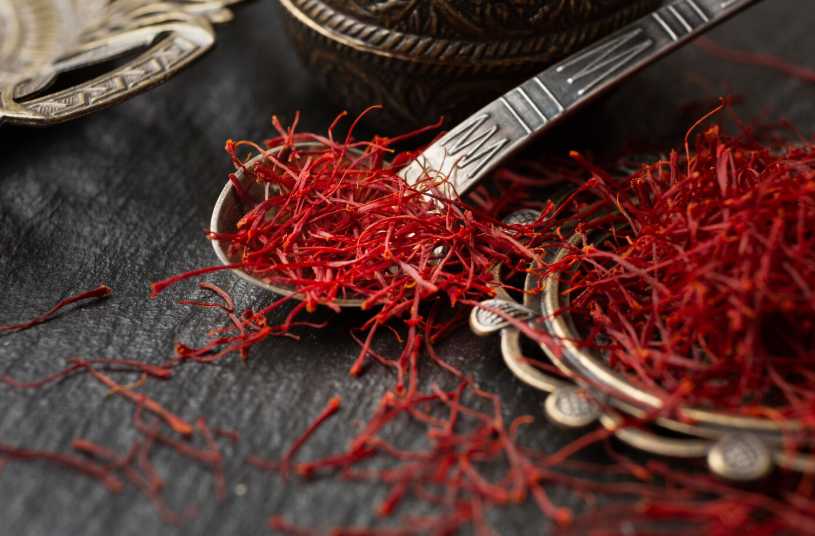
Saffron is widely used as a culinary seasoning, but its applications extend beyond food. The spice is also used in traditional medicine, perfumes and textile dyes. Known for its characteristic sweet, honey-like fragrance combined with a grassy, hay-like aroma, saffron also plays a role in certain religious and cultural ceremonies, particularly in India.
Compared with 2021, when worldwide saffron exports totaled around $287.9 million, the global export value increased by a modest 2.6% over five years.
On a year-over-year basis, however, the market remained almost unchanged. Saffron exports increased by just 0.5% from 2024, when global shipments were valued at approximately $293.9 million.
Global Saffron Export and Import Overview
International saffron trade is highly concentrated among a relatively small number of exporting countries.
The five largest saffron exporters in 2025 were:
· Iran
· Spain
· Afghanistan
· United Arab Emirates
· India
Together, these five suppliers accounted for 90.3% of total global saffron export value in 2025.
The import side of the market was somewhat more diversified. The leading five saffron-buying markets were:
· Spain
· India
· mainland China
· Italy
· Saudi Arabia
Combined, these five destinations represented 59.5% of worldwide saffron import spending.
This difference in concentration highlights an important feature of the saffron trade: supply is dominated by a relatively small group of exporters, while demand is distributed across a broader range of international markets.
Where Does Most Saffron Come From?
Asia was the leading source of saffron exports in 2025.
Asian exporters generated approximately $200.5 million in saffron shipments, representing 67.9% of the global export total.
European suppliers ranked second, accounting for 31.5% of worldwide saffron exports.
The remaining export value came from several smaller regions:
· North America: 0.4%
· Africa: 0.08%
· Latin America and the Caribbean: 0.06%
· Oceania: 0.05%, mainly Australia and New Zealand
The strong share held by Asian exporters is largely connected to the importance of major saffron-producing and trading markets in the region.
Main Destinations for Imported Saffron
Europe was the largest destination for internationally traded saffron in 2025.
European markets received approximately 50.9% of global saffron imports, making the region the largest destination by value.
Asian buyers followed with 36.5%, while importers in North America accounted for another 7.5%.
Other regions represented smaller portions of worldwide saffron purchases:
· Latin America and the Caribbean: 3.7%, excluding Mexico but including the Caribbean
· Oceania: 0.9%, led by Australia and New Zealand
· Africa: 0.5%
The distribution of imports indicates that saffron demand extends well beyond its major producing regions, with European and Asian markets together accounting for the majority of global purchases.
Saffron Trade Market Concentration
The global saffron market involves approximately 72 exporting countries, compared with around 157 importing countries, islands and territories.
The top five exporters alone generated 90.3% of global export value, demonstrating the highly concentrated nature of the supply side.
By comparison, the top five importers accounted for 59.5% of global saffron imports, indicating a broader distribution of international demand.
For businesses involved in saffron sourcing or international distribution, these figures can help identify both the world's major supply centers and the markets where purchasing demand is concentrated.
For international trade research and customs data analysis, saffron is classified under the 6-digit Harmonized System (HS) code 091020.
Using HS 091020 can help businesses track saffron shipments, analyze import and export markets, compare trading activity across countries and identify potential suppliers or buyers.
Top Saffron Exports by Country
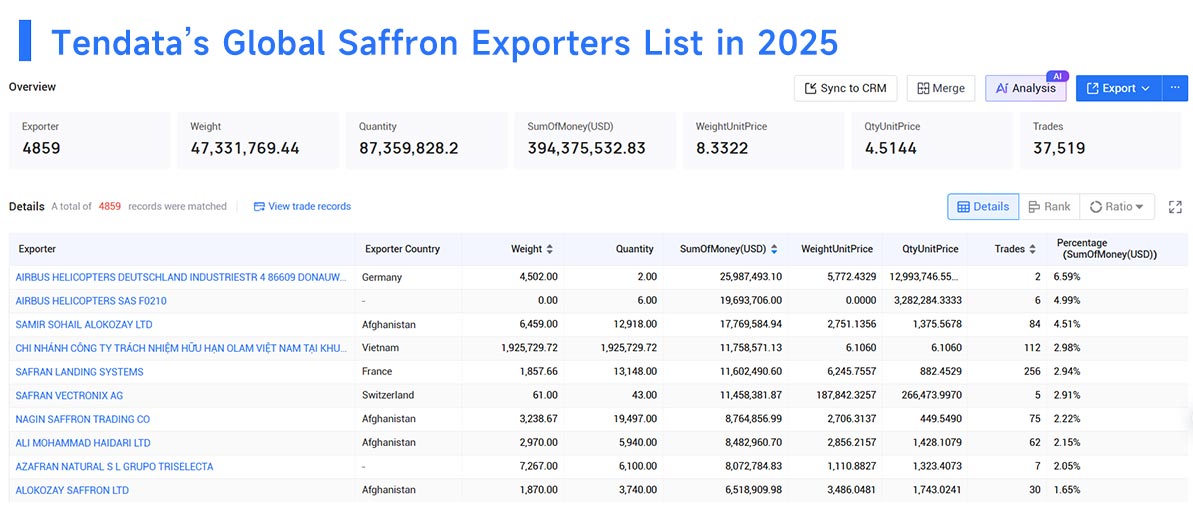
According totendata export data, these are the top 10 Saffron exporters in 2025:
>>Find More Exporters through Tendata
1.AIRBUS HELICOPTERS DEUTSCHLAND INDUSTRIESTR 4 86609 DONAUWORTH GERMANY(6.59%, $25.99 Million)
2.SAMIR SOHAIL ALOKOZAY LTD(4.51%, $17.77 Million)
3.CHI NHÁNH CÔNG TY TRÁCH NHIỆM HỮU HẠN OLAM VIỆT NAM TẠI KHU CÔNG NGHIỆP BIÊN HÒA II(2.98%, $11.76 Million)
4.SAFRAN LANDING SYSTEMS(2.94%, $11.6 Million)
5.NAGIN SAFFRON TRADING CO(2.22%, $8.76 Million)
6.ALI MOHAMMAD HAIDARI LTD(2.15%, $8.48 Million)
7.AZAFRAN NATURAL S L GRUPO TRISELECTA(2.05%, $8.07 Million)
8.ALOKOZAY SAFFRON LTD(1.65%, $6.52 Million)
9.MESSIER GOODRICH S A(1.45%, $5.74 Million)
10.CÔNG TY CỔ PHẦN HÀNG KHÔNG VIETJET(1.45%, $5.73 Million)
Top Saffron Imports by Country
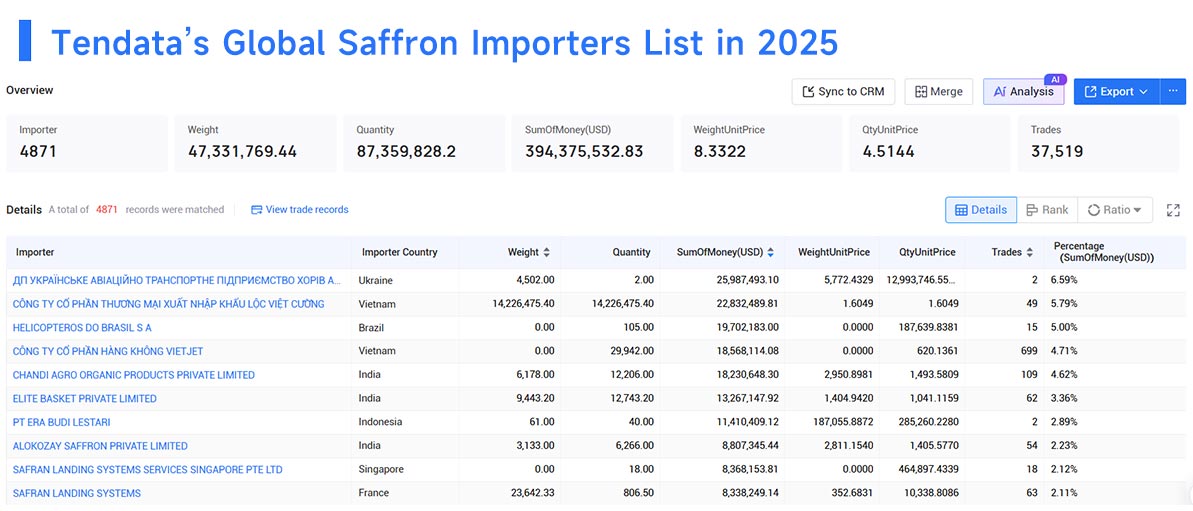
According totendata import data, these are the top 10 Saffron importers in 2025:
>>See More Importers with Tendata
1.ДП УКРАЇНСЬКЕ АВІАЦІЙНО ТРАНСПОРТНЕ ПІДПРИЄМСТВО ХОРІВ АВІА(6.59%, $25.99 Million)
2.CÔNG TY CỔ PHẦN THƯƠNG MẠI XUẤT NHẬP KHẨU LỘC VIỆT CƯỜNG(5.79%, $22.83 Million)
3.HELICOPTEROS DO BRASIL S A(5%, $19.7 Million)
4.CÔNG TY CỔ PHẦN HÀNG KHÔNG VIETJET(4.71%, $18.57 Million)
5.CHANDI AGRO ORGANIC PRODUCTS PRIVATE LIMITED(4.62%, $18.23 Million)
6.ELITE BASKET PRIVATE LIMITED(3.36%, $13.27 Million)
7.PT ERA BUDI LESTARI(2.89%, $11.41 Million)
8.ALOKOZAY SAFFRON PRIVATE LIMITED(2.23%, $8.81 Million)
9.SAFRAN LANDING SYSTEMS SERVICES SINGAPORE PTE LTD(2.12%, $8.37 Million)
10.SAFRAN LANDING SYSTEMS(2.11%, $8.34 Million)
Top Saffron Exporters by Country
Global saffron exports totaled approximately US$295.4 million in 2025. Although saffron is traded across many international markets, export supply remains heavily concentrated among a small group of countries.
The following 15 countries recorded the highest saffron export values in 2025:
1. Iran: US$115.6 million (39.1% of global saffron exports)
2. Spain: $70.9 million (24%)
3. Afghanistan: $67.1 million (22.7%)
4. United Arab Emirates: $7.2 million (2.4%)
5. India: $6 million (2%)
6. France: $5.4 million (1.8%)
7. Oman: $3.1 million (1%)
8. Netherlands: $2.5 million (0.9%)
9. Poland: $2.5 million (0.8%)
10. Italy: $2.2 million (0.7%)
11. Greece: $2 million (0.7%)
12. Belgium: $1.9 million (0.6%)
13. Germany: $1.6 million (0.6%)
14. Austria: $1.1 million (0.4%)
15. Canada: $898,000 (0.3%)
Together, these 15 exporters generated 98.2% of worldwide saffron export value in 2025, underlining the strong concentration of global saffron supply.
Fastest-Growing Saffron Exporters
Several major saffron-exporting markets recorded substantial increases between 2024 and 2025.
Canada registered the fastest growth among the listed exporters, with saffron export value surging 203.4%. It was followed by India, where exports increased 67.1%, while Spain and France recorded gains of 26.2% and 25.7%, respectively.
These changes point to shifts in saffron export activity across both established and emerging suppliers.
Saffron Exporters with Declining Sales
Some leading exporters experienced significant year-over-year contractions.
The Netherlands recorded the sharpest decline, with saffron export value falling 70.4% from 2024. Other notable decreases were reported by the United Arab Emirates, down 45.7%, and Oman, down 43.2%.
Exports from Belgium decreased by 26.6%, while Greece posted an 18.2% decline.
Top Saffron Importers by Country
Global spending on imported saffron reached approximately US$288.5 million in 2025.
Compared with 2021, worldwide saffron import expenditure increased by 18.7%. Import demand also expanded on a year-over-year basis, rising 3.9% from 2024.
The following 15 countries were the largest saffron-importing markets by value in 2025:
1. Spain: US$68.1 million (23.6% of global saffron imports)
2. India: $39.8 million (13.8%)
3. mainland China: $23.4 million (8.1%)
4. Italy: $20.4 million (7.1%)
5. Saudi Arabia: $19.9 million (6.9%)
6. United States: $17.9 million (6.2%)
7. France: $14.5 million (5%)
8. Sweden: $11.2 million (3.9%)
9. Argentina: $9.1 million (3.2%)
10. Germany: $7.8 million (2.7%)
11. United Kingdom: $5.8 million (2%)
12. Oman: $5.3 million (1.8%)
13. Switzerland: $4.5 million (1.6%)
14. United Arab Emirates: $4.5 million (1.5%)
15. Belgium: $4.4 million (1.5%)
Collectively, these 15 markets accounted for 88.9% of global saffron import spending in 2025.
Fastest-Growing Saffron Import Markets
Among the leading importing countries, Argentina recorded the strongest year-over-year expansion. Its saffron imports increased by 248.1% compared with 2024.
Other major growth markets included Sweden, where imports rose 43.4%, and mainland China, which increased its saffron purchases by 42.5%. Belgium also recorded solid growth of 27.5%.
These increases indicate that saffron purchasing activity expanded considerably in several major consumer and trading markets during 2025.
Countries with Lower Saffron Import Demand
Not all major buying markets increased their saffron purchases.
The United Arab Emirates recorded the largest decline among the leading importers, with import value dropping 76.3% from 2024.
Oman also experienced a significant reduction of 31.5%, while saffron imports into the United States decreased by a comparatively modest 1.9%.
What the Saffron Trade Data Shows
The 2025 trade figures highlight a highly concentrated saffron supply chain. The top 15 exporting countries accounted for 98.2% of global exports, while the top 15 importing markets represented 88.9% of worldwide import value.
For companies involved in saffron sourcing, distribution or international sales, analyzing both sides of the trade flow can provide a clearer picture of where supply is concentrated and which markets are actively purchasing saffron.
Using country-level statistics together with company-level shipment data can further help businesses identify active exporters and importers, examine trading patterns and develop more targeted international sourcing or sales strategies.
Category
Leave Message for Demo Request or Questions