
 Exhibition
 B2B Platforms
 Standalone Website
 Social Media
 Emails
Top 10 Pakistan Import World Trade Stats by Product & Company in 2025 – Tendata
 Import News
 2026-10-08
Pakistan remains an important import market in South Asia, with strong demand for energy products, industrial machinery, electrical equipment, raw materials, and consumer goods. As international supply chains continue to evolve, analyzing world trade stats helps businesses understand Pakistan's import structure, identify major trading partners, and evaluate opportunities across different product categories.
In 2025, Pakistan's total merchandise imports reached approximately US$65.17 billion, according to UN Comtrade-based statistics. The country's import market was primarily driven by mineral fuels, electrical machinery, industrial equipment, and manufacturing materials.
Pakistan's import performance has experienced several fluctuations in recent years. Following a significant contraction in 2023, merchandise imports recovered during 2024 and continued expanding in 2025. This recovery reflected renewed purchasing activity across major import-dependent industries, although demand remained sensitive to foreign exchange conditions, energy prices, and domestic economic policies.
According to Tendata global trade data, analyzing Pakistan's import market through detailed world trade stats allows exporters and international suppliers to move beyond general trade figures and examine actual purchasing activities. By reviewing product categories, shipment records, trading companies, and sourcing patterns, businesses can better understand where import demand is concentrated.

Pakistan's Top 10 Import Categories in 2025
Pakistan's import market covers a wide range of commodities, with energy resources and industrial products accounting for a substantial proportion of total imports.
Based on 2025 UN Comtrade data reported by Trading Economics, the following product categories generated the highest import values in Pakistan, along with their approximate shares of total imports.
1. Mineral fuels, oils, and distillation products — US$16.72 billion, accounting for approximately 25.7%.
2. Electrical and electronic equipment — US$6.47 billion, accounting for approximately 9.9%.
3. Animal and vegetable fats and oils — US$4.37 billion, accounting for approximately 6.7%.
4. Machinery and mechanical appliances — US$4.28 billion, accounting for approximately 6.6%.
5. Iron and steel — US$4.13 billion, accounting for approximately 6.3%.
6. Vehicles other than railway or tramway equipment — US$3.18 billion, accounting for approximately 4.9%.
7. Plastics and plastic products — US$2.78 billion, accounting for approximately 4.3%.
8. Organic chemicals — US$2.75 billion, accounting for approximately 4.2%.
9. Cotton — US$2.08 billion, accounting for approximately 3.2%.
10. Oil seeds and oleaginous fruits — US$1.59 billion, accounting for approximately 2.4%.
These categories highlight Pakistan's dependence on imported energy, manufacturing inputs, industrial equipment, and agricultural commodities.
Mineral fuels represented the largest import category, reflecting the country's energy requirements. Meanwhile, machinery, electrical equipment, and industrial materials supported manufacturing, infrastructure development, and other economic activities.
For international suppliers, these world trade stats provide an overview of Pakistan's major import sectors. However, understanding which companies are actively purchasing specific products requires more detailed company-level trade information.
This is where Tendata provides additional value. By combining country-level trade analysis with company-level customs records, businesses can identify potential buyers, examine purchasing behavior, and evaluate sourcing opportunities in the Pakistani market.
Top 10 Overseas Import Companies of Pakistani Onions in 2025
Beyond Pakistan's overall import market, company-level trade records can also reveal international demand for products exported from Pakistan.
For example, when researching onion demand, Tendata's platform can identify overseas companies importing onions from Pakistan. These records help Pakistani exporters discover active international buyers and evaluate potential export markets.
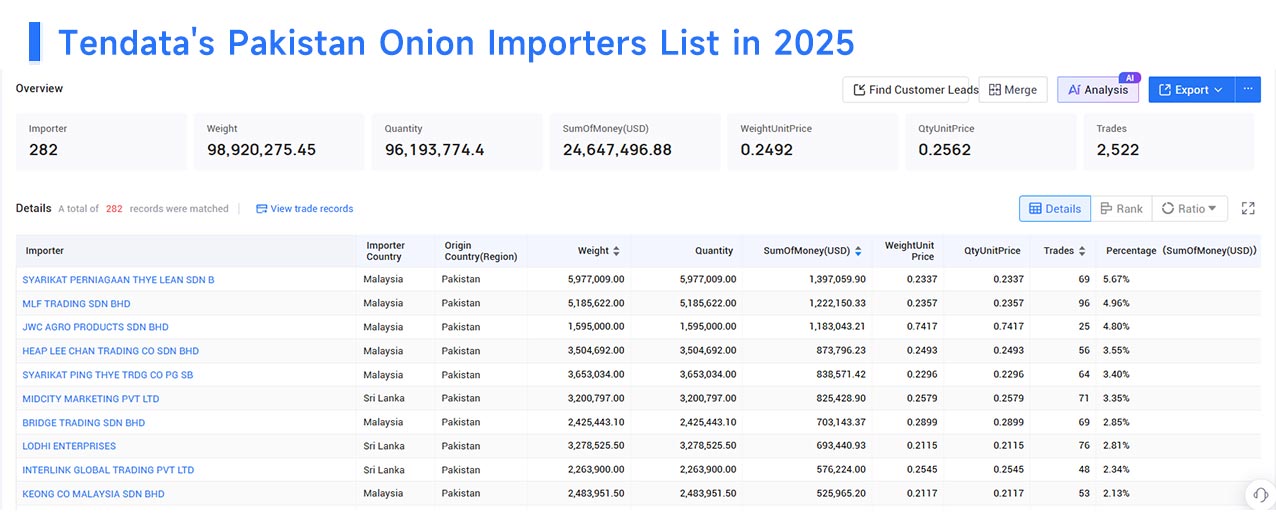
According to Tendata global trade data, the platform recorded 282 overseas onion importers, 2,522 trades, and a total recorded trade value of US$24,647,496.88 within the selected 2025 dataset.
The following companies ranked among the leading overseas importers of Pakistani onions in 2025, based on the recorded import values.
1. SYARIKAT PERNIAGAAN THYE LEAN SDN B — US$1,397,059.90, accounting for 5.67%.
2. MLF TRADING SDN BHD — US$1,222,150.33, accounting for 4.96%.
3. JWC AGRO PRODUCTS SDN BHD — US$1,183,043.21, accounting for 4.80%.
4. HEAP LEE CHAN TRADING CO SDN BHD — US$873,796.23, accounting for 3.55%.
5. SYARIKAT PING THYE TRDG CO PG SB — US$838,571.42, accounting for 3.40%.
6. MIDCITY MARKETING PVT LTD — US$825,428.90, accounting for 3.35%.
7. BRIDGE TRADING SDN BHD — US$703,143.37, accounting for 2.85%.
8. LODHI ENTERPRISES — US$693,440.93, accounting for 2.81%.
9. INTERLINK GLOBAL TRADING PVT LTD — US$576,224.00, accounting for 2.34%.
10. KEONG CO MALAYSIA SDN BHD — US$525,965.20, accounting for 2.13%.
>>> Find More Pakistan Onion Importers via Tendata <<<
Data Source: Tendata Platform
The results indicate that Malaysia and Sri Lanka were important destination markets within these Pakistani onion trade records.
Among the listed companies, SYARIKAT PERNIAGAAN THYE LEAN SDN B ranked first, with an import value exceeding US$1.39 million across 69 recorded trades. MLF TRADING SDN BHD followed with approximately US$1.22 million and 96 trades, indicating substantial purchasing activity during the selected period.
JWC AGRO PRODUCTS SDN BHD also represented a significant buyer, accounting for 4.80% of the recorded trade value. Meanwhile, companies such as MIDCITY MARKETING PVT LTD and LODHI ENTERPRISES demonstrated the presence of Sri Lankan buyers in the market.
These company-level world trade stats reveal information that aggregate country statistics cannot provide, including the identities of active buyers, their recorded purchasing values, and their trading frequency.
For Pakistani onion exporters, this information can support more targeted customer development. Instead of approaching potential buyers without verified trading activity, exporters can prioritize companies with established import records and evaluate their purchasing patterns.
For international traders, Tendata makes it possible to examine similar shipment-level information across different products, countries, and trading companies.
How Tendata Helps Businesses Analyze Pakistan World Trade Stats
Understanding Pakistan's international trade requires more than reviewing annual import values. Businesses also need reliable information about individual importers, exporters, product demand, and actual shipment activities.
With Tendata, companies can explore detailed world trade stats and transform trade records into practical market intelligence.
Identify Active Importers and Exporters
Tendata allows businesses to search for companies involved in international trade based on specific products, countries, and customs records.
For example, suppliers targeting Pakistan can research Pakistani importers within relevant product categories. Similarly, Pakistani exporters can identify overseas buyers purchasing products such as onions, rice, textiles, and agricultural commodities.
Analyze Purchasing Trends and Trade Activities
By examining historical shipment records, businesses can understand how frequently companies trade, which products they purchase, and how their sourcing activities change over time.
These detailed world trade stats help companies evaluate buyer activity and identify potential opportunities for long-term business relationships.
Discover Potential Customers in International Markets
Tendata also supports customer development by helping businesses identify companies with relevant trading histories.
Rather than relying entirely on general company directories, exporters can use customs-based information to build targeted prospect lists and prioritize businesses that have demonstrated purchasing activity.
Combined with broader world trade stats, these insights can help companies make more informed decisions about market selection, customer outreach, and international expansion.
Summary
Pakistan's import market remained significant in 2025, with total merchandise imports reaching approximately US$65.17 billion. Energy products, electrical equipment, machinery, and industrial materials represented some of the country's largest import categories.
At the company level, Tendata's Pakistani onion trade records also demonstrate how international shipment information can reveal active overseas buyers and their purchasing behavior.
For exporters, importers, and international suppliers, combining national world trade stats with detailed company-level customs records provides a more comprehensive understanding of global trade opportunities.
With Tendata, businesses can research import and export markets, identify active trading companies, analyze shipment histories, and develop more targeted international business strategies.
Explore Pakistan's import and export opportunities with Tendata. Access detailed trade records, discover potential buyers and suppliers, and request a personalized demonstration to see how Tendata can support your global business development.
Category
Leave Message for Demo Request or Questions