 Exhibition
 B2B Platforms
 Standalone Website
 Social Media
 Emails
Global Russia Import Shipment Data by Country & Company in 2025 – Tendata
 Import News
 2026-10-10
Russia remains an important participant in international trade, with its import market covering machinery, electrical equipment, vehicles, pharmaceuticals, chemicals, and a wide range of consumer products. Despite geopolitical tensions, international sanctions, and changes in global supply chains, Russia continues to rely on overseas suppliers to support domestic manufacturing, industrial development, and consumer demand.
Russia's merchandise imports have experienced considerable fluctuations in recent years. Following a sharp decline in 2022, imports recovered in 2023 as Russian businesses developed alternative sourcing channels and expanded trade relationships with Asian countries. China has become an especially important supplier, while countries such as Türkiye, India, and several Eurasian trading partners continue to participate in Russia's import market.
In 2025, Russia's import performance remained closely connected to exchange-rate movements, domestic demand, international payment restrictions, and evolving logistics networks. These factors influenced both the composition of imported goods and the countries supplying them.
For exporters and international suppliers, analyzing Russia import shipment data provides valuable insights into market demand, sourcing patterns, and potential business opportunities.
At Tendata, we help businesses explore global trade activity through detailed customs records, company-level shipment information, and international market analysis. By examining import shipment records, exporters can identify active importers, understand purchasing behavior, and evaluate potential opportunities in Russia and related Eurasian markets.
Unlike aggregate trade statistics, company-level import shipment data provides greater visibility into individual transactions, helping businesses connect broader market trends with actual trading activity.
According to the Federal Customs Service of Russia, the country's merchandise imports reached US$279.0 billion in 2025, representing a 1.4% decrease from US$282.8 billion in 2024. Total foreign trade turnover reached US$697.3 billion, while Asian trading partners accounted for approximately 73.4% of Russia's total trade activity.
These figures highlight the importance of monitoring Russia import shipment activity at both the national and company levels. While overall imports declined slightly, opportunities continued to vary significantly across individual product categories and supply chains.

Russia's Top 10 Import Categories in 2025
Russia's import market is characterized by strong demand for industrial equipment, technology products, healthcare supplies, and consumer goods. Understanding the distribution of major import categories helps exporters identify industries with substantial purchasing activity.
Based on publicly available 2025 import statistics, the following product categories were among Russia's leading imports. The percentages below are based on the category-level dataset published by World’s Top Exports, which uses a narrower coverage basis than the Federal Customs Service's total import figure cited above.
1. Machinery including computers — US$33.6 billion, accounting for 18.5% of total imports.
2. Electrical machinery and equipment — US$17.6 billion, accounting for 9.7%.
3. Vehicles — US$16.6 billion, accounting for 9.1%.
4. Pharmaceuticals — US$14.1 billion, accounting for 7.7%.
5. Optical, technical, and medical apparatus — US$7.4 billion, accounting for 4.1%.
6. Plastics and plastic articles — US$6.3 billion, accounting for 3.5%.
7. Organic chemicals — US$5.1 billion, accounting for 2.8%.
8. Fruits and nuts — US$4.6 billion, accounting for 2.5%.
9. Inorganic chemicals — US$4.0 billion, accounting for 2.2%.
10. Articles of iron or steel — US$3.6 billion, accounting for 2.0%.
Machinery, electrical equipment, and vehicles collectively represent a significant portion of the listed import categories, reflecting Russia's continued dependence on international suppliers for industrial production, technological development, and transportation.
Pharmaceuticals and medical equipment also remain important import segments, indicating continued demand for healthcare-related products and specialized technologies.
For businesses seeking opportunities in these industries, Russia import shipment data can provide more detailed information about the companies involved in international purchasing.
By analyzing product descriptions, shipment values, trading partners, and purchasing frequency, exporters can better understand which businesses are actively sourcing specific products.
At Tendata, we combine international trade statistics with company-level customs records to help businesses move beyond general market research and identify potential customers based on actual trading activity.
Top 10 Import Companies Trading LED Products from Russia in 2025
LED products represent an important segment of the electrical equipment industry, with applications across commercial lighting, industrial facilities, residential construction, and electronic systems.
For example, when researching LED demand, Tendata's platform can identify active importers purchasing LED-related products from Russia, helping exporters understand cross-border trading relationships and discover potential buyers in neighboring markets.
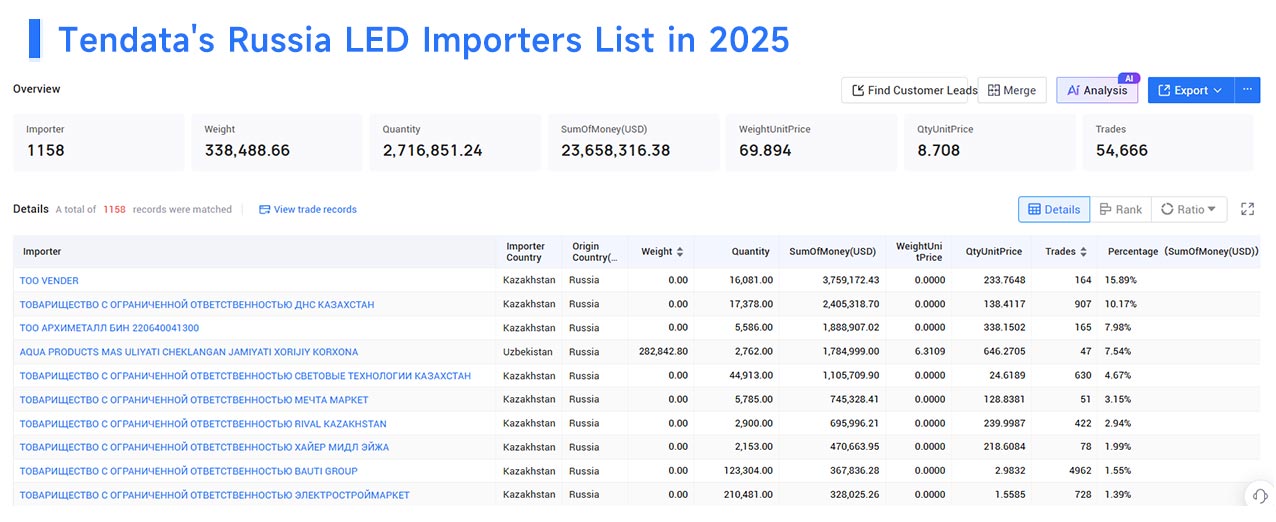
According to Tendata global trade data, the selected 2025 LED dataset records 1,158 importers, 54,666 trade transactions, and a total recorded trade value of US$23,658,316.38.
The following companies ranked among the leading importers of LED-related products originating from Russia in the selected dataset. Most were located in Kazakhstan, with one company based in Uzbekistan.
1. ТОО VENDER — US$3,759,172.43, accounting for 15.89% of the recorded trade value.
2. ТОВАРИЩЕСТВО С ОГРАНИЧЕННОЙ ОТВЕТСТВЕННОСТЬЮ ДНС КАЗАХСТАН — US$2,405,318.70, accounting for 10.17%.
3. ТОО АРХИМЕТАЛЛ БИН 220640041300 — US$1,888,907.02, accounting for 7.98%.
4. AQUA PRODUCTS MAS ULIYATI CHEKLANGAN JAMIYATI XORIJIY KORXONA — US$1,784,999.00, accounting for 7.54%.
5. ТОВАРИЩЕСТВО С ОГРАНИЧЕННОЙ ОТВЕТСТВЕННОСТЬЮ СВЕТОВЫЕ ТЕХНОЛОГИИ КАЗАХСТАН — US$1,105,709.90, accounting for 4.67%.
6. ТОВАРИЩЕСТВО С ОГРАНИЧЕННОЙ ОТВЕТСТВЕННОСТЬЮ МЕЧТА МАРКЕТ — US$745,328.41, accounting for 3.15%.
7. ТОВАРИЩЕСТВО С ОГРАНИЧЕННОЙ ОТВЕТСТВЕННОСТЬЮ RIVAL KAZAKHSTAN — US$695,996.21, accounting for 2.94%.
8. ТОВАРИЩЕСТВО С ОГРАНИЧЕННОЙ ОТВЕТСТВЕННОСТЬЮ ХАЙЕР МИДЛ ЭЙЖА — US$470,663.95, accounting for 1.99%.
9. ТОВАРИЩЕСТВО С ОГРАНИЧЕННОЙ ОТВЕТСТВЕННОСТЬЮ BAUTI GROUP — US$367,836.28, accounting for 1.55%.
10. ТОВАРИЩЕСТВО С ОГРАНИЧЕННОЙ ОТВЕТСТВЕННОСТЬЮ ЭЛЕКТРОСТРОЙМАРКЕТ — US$328,025.26, accounting for 1.39%.
>>> Find More Russian Buyers via Tendata <<<
Data Source: Tendata Platform
These figures demonstrate how import shipment records can reveal the distribution of purchasing activity across individual companies.
Among the listed businesses, ТОО VENDER recorded the highest import value at approximately US$3.76 million, followed by ДНС КАЗАХСТАН with US$2.41 million and ТОО АРХИМЕТАЛЛ with US$1.89 million.
Together, these three companies accounted for approximately 34.04% of the selected dataset's recorded trade value, indicating a relatively concentrated distribution of purchasing activity among the leading importers.
The presence of multiple Kazakhstan-based businesses also highlights the importance of regional trading relationships involving Russia and other Eurasian markets.
For exporters, these records provide a starting point for evaluating potential customers, understanding product demand, and identifying companies with established import activity.
Through Tendata, businesses can further examine individual import shipment records, compare trading partners, and investigate the purchasing history of companies operating in their target industries.
It is important to note that these companies are importers of goods originating from Russia, rather than companies importing goods into Russia. The dataset therefore illustrates Russia-linked regional trade activity and should not be interpreted as a ranking of Russia's domestic importers.
Identify Potential Buyers with Tendata Import Shipment Data
Understanding national import trends is only the first step in developing an international sales strategy. Exporters also need reliable information about actual buyers, purchasing behavior, and existing supplier relationships.
Tendata provides company-level trade intelligence that helps businesses turn import shipment data into practical opportunities for customer development.
1. Discover Active Importers by Product and Country
With Tendata, exporters can search import shipment records by product name, HS code, country, and company to identify businesses involved in relevant international transactions.
For example, an LED manufacturer can examine import activity in Russia or neighboring markets to discover companies purchasing lighting products and related electrical equipment.
This approach helps sales teams prioritize businesses with documented purchasing activity rather than relying entirely on general company directories.
2. Analyze Purchasing Patterns and Supplier Relationships
Individual import shipment records can provide useful information about shipment frequency, transaction values, product descriptions, and trading partners.
By reviewing historical transactions, exporters can evaluate whether a potential customer purchases products regularly, identify existing supplier relationships, and assess the company's relevance to their business.
According to Tendata global trade data, company-level trade records can also support comparisons between importers operating within the same product category.
These insights help businesses develop more targeted market entry strategies and approach potential customers with a clearer understanding of their sourcing requirements.
3. Develop High-Quality Sales Leads
Finding importers is valuable, but identifying the right decision-makers is equally important.
Tendata supports B2B customer development by helping users investigate company profiles and access available business contact information, including email addresses and professional social media profiles.
By combining import shipment intelligence with company research, exporters can build more focused prospect lists and improve the relevance of their outreach.
For businesses expanding into Russia and surrounding markets, this approach can help reduce time spent on unqualified leads while supporting more informed sales decisions.
Summary
Russia remains a significant international import market, with continued demand across machinery, electrical equipment, vehicles, pharmaceuticals, and other major product categories.
In 2025, Russia's merchandise imports reached US$279.0 billion, reflecting a modest decline from the previous year while maintaining substantial international purchasing activity.
Beyond national trade statistics, detailed import shipment data offers additional insights into company-level transactions, purchasing behavior, and regional supply chain relationships.
The Tendata LED trade records illustrate how exporters can identify active importers, evaluate transaction values, and examine trading relationships involving Russia and neighboring markets.
By combining global trade statistics with company-level import shipment records, Tendata helps businesses identify potential customers, analyze market opportunities, and make more informed international trade decisions.
Explore Russia import shipment data with Tendata and discover potential buyers through detailed customs records and company-level trade intelligence. Request a personalized Tendata demo to see how our platform can support your next market expansion.
Category
Leave Message for Demo Request or Questions