 Exhibition
 B2B Platforms
 Standalone Website
 Social Media
 Emails
Top Nickel Import Countries & Companies in 2025 - Tendata
 Import News
 2026-10-12
Worldwide nickel imports reached US$5.1 billion in 2025, reflecting a recovery in import spending compared with the previous year, although the market remained below its 2021 level.
In 2021, international purchases of nickel were valued at $5.9 billion. By 2025, the total had declined by 13.9% over the five-year period. However, on a year-over-year basis, global nickel import value increased by 14.9%, rising from $4.4 billion in 2024.
Nickel is a hard, silvery-white metal with a subtle golden tint. Despite its strength, it is relatively malleable and can be processed into wires and other forms for industrial applications.
One of nickel's most important uses is the production of stainless steel. It is also used in nonferrous alloys, alloy steel and electroplating. Products that may contain nickel include magnets, coins, rechargeable batteries, electric guitar strings and plated plumbing fixtures. Its resistance to corrosion makes it valuable across a range of manufacturing applications.
The five largest nickel-importing markets in 2025 were mainland China, Indonesia, Canada, Finland and Namibia. Combined, these five destinations accounted for 93.8% of global nickel import value, indicating an exceptionally concentrated market.
The latest reporting period recorded just 41 countries importing nickel, further highlighting the limited number of markets represented in international nickel purchasing.
Nickel Imports by Continent
Asia dominated global nickel imports in 2025. Buyers across the region purchased approximately $4.1 billion worth of nickel, representing 81% of worldwide import value.
North America ranked second, accounting for 7.1% of global nickel imports, followed by Europe at 6.6%.
The remaining shares went to importers in Africa, which represented 5.2%; Oceania, at 0.07%, with Australia among the buyers; and Latin America, excluding Mexico but including the Caribbean, at 0.04%.
For trade research purposes, HS code 2604 covers nickel ores and concentrates. Businesses should confirm the applicable tariff classification when researching other nickel products, as unwrought nickel, nickel alloys and finished goods fall under different classifications.

Top 15 Nickel Importing Countries in 2025
The following countries recorded the highest import values for nickel in 2025, ranked by their share of total global imports.
1. Mainland China: US$3.1 billion (60.7% of global nickel imports)
2. Indonesia: $747.3 million (14.8%)
3. Canada: $357.3 million (7.1%)
4. Finland: $312.2 million (6.2%)
5. Namibia: $261.2 million (5.2%)
6. South Korea: $205.5 million (4.1%)
7. Japan: $56 million (1.1%)
8. Malaysia: $15.2 million (0.3%)
9. Belgium: $8.3 million (0.2%)
10. Spain: $6 million (0.1%)
11. Germany: $3.9 million (0.1%)
12. Australia: $3.7 million (0.1%)
13. United Arab Emirates: $3.7 million (0.1%)
14. South Africa: $2.3 million (0.05%)
15. Brazil: $1.8 million (0.04%)
Together, these 15 countries accounted for 99.9% of worldwide nickel imports in 2025, showing that global purchasing activity was concentrated among a small number of markets.
Mainland China alone represented 60.7% of the total, making it by far the largest destination in the supplied data. Indonesia ranked second with a 14.8% share, while Canada, Finland and Namibia formed the next tier of major importers.
Fastest-Growing Nickel Import Markets
Several markets recorded substantial year-over-year increases in nickel imports between 2024 and 2025. Indonesia led the highlighted group, with import value rising by 62.4%. Japan followed with growth of 44.9%, while Belgium and South Africa recorded increases of 32.3% and 19.8%, respectively.
Not all markets moved in the same direction. Malaysia experienced the steepest decline among the listed countries, with nickel import value falling by 42.2%. Brazil recorded a decrease of 28.9%, while South Korea's imports edged down by 1.8%.
These differences show why year-over-year comparisons are useful when evaluating international nickel markets. Rising import values may point to changes in industrial demand, processing activity or supply-chain flows, while declines can signal shifts in purchasing patterns. Further research is needed to determine the specific factors behind each market's performance.
Leading Nickel Importing Companies in 2025
Country-level statistics help identify major import destinations, but company-level trade intelligence can provide another layer of insight into individual businesses and their trading activity.
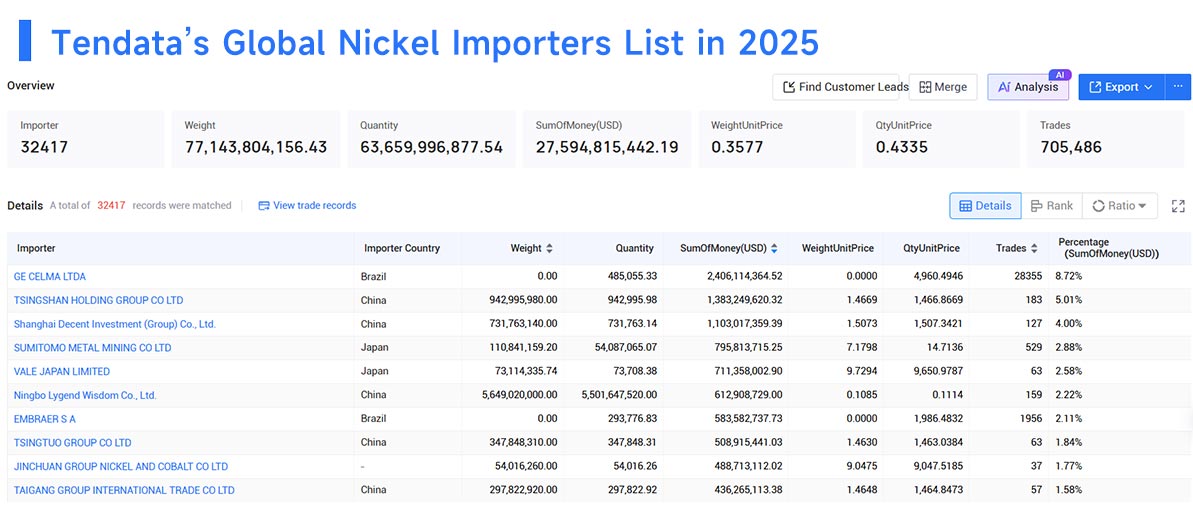
According toTendata, the following companies are listed among the leading nickel importers in the supplied 2025 dataset. The reported percentages and values are reproduced as provided.
>>View More Global Buyers in Tendata
1. GE CELMA LTDA — 8.72%, US$2,406.11 million
2. TSINGSHAN HOLDING GROUP CO LTD — 5.01%, $1,383.25 million
3. Shanghai Decent Investment (Group) Co., Ltd. — 4%, $1,103.02 million
4. SUMITOMO METAL MINING CO LTD — 2.88%, $795.81 million
5. VALE JAPAN LIMITED — 2.58%, $711.36 million
6. Ningbo Lygend Wisdom Co., Ltd. — 2.22%, $612.91 million
7. EMBRAER S A — 2.11%, $583.58 million
8. TSINGTUO GROUP CO LTD — 1.84%, $508.92 million
9. JINCHUAN GROUP NICKEL AND COBALT CO LTD — 1.77%, $488.71 million
10. TAIGANG GROUP INTERNATIONAL TRADE CO LTD — 1.58%, $436.27 million
For businesses operating in the metals, mining and manufacturing sectors, identifying major importers can help guide market research and potential business development. Before approaching a company, it is useful to examine its relevant product categories, import history, sourcing markets and trading frequency.
Global nickel import statistics provide a useful starting point for understanding where international purchasing activity is concentrated. However, country rankings alone cannot show which companies import particular nickel products, which suppliers they work with or how their sourcing patterns change over time.
Tendata's global trade data platform helps businesses research international trade flows, investigate company-level trading activity and explore potential buyers and suppliers. Where the relevant records are available, these insights can support market screening, competitor research and supply-chain analysis.
Companies can use global trade data to:
· Identify potential buyers: Research businesses involved in importing nickel and related products.
· Analyze target markets: Compare import values and annual changes across countries.
· Research sourcing relationships: Examine available shipment records to understand trade flows between buyers and suppliers.
· Evaluate business opportunities: Use company profiles and relevant trade records to support initial partner screening.
For nickel producers, traders and industrial suppliers, combining country-level statistics with company-level trade intelligence can provide a more detailed view of the market. This data-driven approach helps businesses narrow their research, prioritize relevant markets and make more informed decisions about international expansion.
Category
Leave Message for Demo Request or Questions