 Exhibition
 B2B Platforms
 Standalone Website
 Social Media
 Emails
Top 10 Bangladesh's Imports by Products & Company in 2025 - Tendata
 Import News
 2026-08-31
Bangladesh imported an estimated US$65.6 billion worth of products from international suppliers in 2025, making the South Asian country an important market for a wide range of commodities, industrial inputs and manufactured goods.
The total value of Bangladesh's imports declined by 16.2% compared with 2021, when the country purchased approximately $78.3 billion worth of products from overseas suppliers.
Imports also decreased on a year-over-year basis. Bangladesh's import spending in 2025 was 5.5% lower than the $69.4 billion recorded in 2024.
Based on average exchange rates for 2025, the Bangladeshi taka appreciated by 30.1% against the US dollar compared with 2021 and strengthened another 5.4% from 2024 to 2025. A stronger taka means products priced in US dollars generally become relatively less expensive for Bangladeshi buyers when converted into the local currency.
With a population of approximately 174 million, Bangladesh's total imports of $65.6 billion in 2025 correspond to around $380 in imported goods for every resident. This figure was slightly higher than the approximately $370 per-capita level recorded in 2024.

Bangladesh's Top 10 Imports
The following product categories represented Bangladesh's largest import purchases by value during 2025. The percentage beside each category indicates its share of Bangladesh's total imports.
1. Mineral fuels including oil: US$8.9 billion (13.6% of total imports)
2. Cotton: $7.5 billion (11.5%)
3. Machinery including computers: $4.6 billion (7%)
4. Electrical machinery and equipment: $3.3 billion (5%)
5. Iron and steel: $3.3 billion (5%)
6. Plastics and plastic articles: $2.7 billion (4.1%)
7. Animal or vegetable fats, oils and waxes: $2.6 billion (4%)
8. Knit or crochet fabric: $2.4 billion (3.7%)
9. Cereals: $2.24 billion (3.4%)
10. Fertilizers: $2.19 billion (3.3%)
Together, these 10 major import categories accounted for 60.5% of Bangladesh's total import expenditure in 2025, representing close to three-fifths of all products purchased from foreign suppliers.
Fastest-Growing Imports in Bangladesh
Among Bangladesh's leading import categories, cereals recorded the strongest growth, with purchases increasing by 111.6% from 2024 to 2025.
Fertilizer imports ranked second in terms of growth, rising 31.7%, while imports of animal or vegetable fats, oils and waxes increased by 29.2%.
Several major import categories experienced significant declines. Imports of mineral fuels including oil fell 21.5%, while machinery and computers decreased by 19.8%. Electrical machinery and equipment also declined by 10.2% compared with the previous year.
The product categories above are classified according to the 2-digit Harmonized Tariff System (HTS). More specific product-level information can be obtained by examining the corresponding 4-digit HTS codes.
Bangladesh's Most Imported Products
Looking at the more detailed 4-digit HTS classification, Bangladesh's leading imported products in 2025 included:
1. Processed petroleum oils: 8.1% of total imports
2. Raw cotton: 3.7%
3. Cotton yarn: 2.8%
4. Palm oil: 2.6%
5. Iron or steel scrap: 2.5%
6. Fertilizer mixtures: 2.2%
7. Synthetic yarn woven fabrics: 2.2%
8. Cotton woven fabrics: 2%
9. Coal and other solid fuels made from coal: 2%
10. Electrical energy: 1.9%
Collectively, these 10 products represented approximately 30% of Bangladesh's total imports in 2025, highlighting the country's strong demand for energy products, textile materials, industrial inputs and agricultural commodities.
Bangladesh Importers Database
Finding the right buyers in Bangladesh can be difficult when relying only on general business directories or online searches. Shipment-level import data provides a more direct way to identify companies that are actively purchasing products from international suppliers.
Tendata's Global Importers & Exporters Finder enables suppliers to search Bangladesh importers using product keywords, HS codes, company names and other trade-related criteria. This allows exporters to identify active buyers and evaluate their purchasing activity before beginning sales outreach.
Bangladesh Importers Directory
Tendata provides access to a large database of Bangladesh importers, supported by real shipment data. Importer profiles can include company information, product details, HS codes, shipment records, import volumes and trading relationships.
By analyzing actual import activity, exporters can narrow down potential buyers based on the products they purchase and their historical sourcing behavior.
Tendata also combines trade records with business and contact information, helping suppliers move from buyer discovery to prospect evaluation and outreach more efficiently.
List of Bangladesh Importers
Tendata's Bangladesh importer database includes thousands of companies involved in international trade. Users can search for potential buyers by product, HS code, company name and other relevant criteria, making it easier to identify companies that match a specific product offering.
For example, based on PVC-related shipment data, Tendata identified the following leading Bangladesh importers in 2025:>>Find More Bangladesh Buyers
1. MEGHNA PVC LIMITED — 18.92%, $96.68 million
2. RFL PLASTICS LIMITED — 6.1%, $31.17 million
3. BANGA BUILDING MATERIALS LIMITED — 3.28%, $16.75 million
4. A ONE POLYMER LIMITED — 3.27%, $16.72 million
5. ISMARTU TECHNOLOGY BD LIMITED — 2.91%, $14.85 million
6. AKIJ PLASTICS LIMITED — 2.22%, $11.32 million
7. LIRA INDUSTRIAL ENTERPRISE LIMITED — 2.13%, $10.91 million
8. BRB CABLE INDUSTRIES LTD — 2.13%, $8.66 million
9. M S KULSUMA PLASTIC — 1.69%, $6.84 million
10. BENLI ELECTRONIC ENTERPRISE CO — 1.34%, $6.72 million
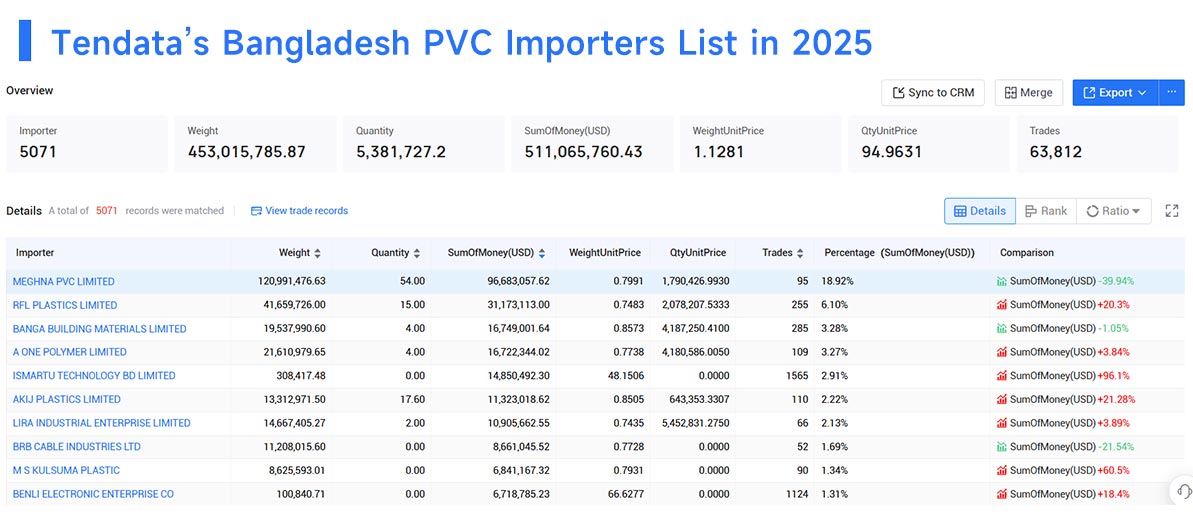
For exporters targeting Bangladesh, analyzing real import records can reveal not only who the potential buyers are, but also what they purchase, how frequently they import and the scale of their international sourcing activity.
Category
Leave Message for Demo Request or Questions