
 Exhibition
 B2B Platforms
 Standalone Website
 Social Media
 Emails
Global Tomatoes Imports by Country & Company in 2025 - Tendata
 Import News
 2026-09-10
Global spending on imported tomatoes reached approximately US$11.6 billion in 2025.
International purchases of tomatoes grew by 10% compared with 2021, when total global imports were valued at around $10.5 billion. However, on a year-over-year basis, worldwide spending on imported tomatoes declined by 4.6% from the $12.1 billion recorded in 2024.
The leading international markets for imported tomatoes in 2025 were the United States, Germany, France, the United Kingdom and Poland. Together, these five countries accounted for approximately 63.7% of global spending on fresh or chilled tomatoes imported during the year.
Global Tomato Import Markets by Region
Looking at imports by continent, European countries represented the largest destination for imported tomatoes in 2025. Buyers across Europe purchased approximately $7.73 billion worth of tomatoes, equivalent to 66.9% of the global total.
North America ranked second, accounting for 28.2% of worldwide tomato imports.
Other regions represented much smaller shares:
· Asia: 3.7%
· Africa: 0.74%
· Latin America and the Caribbean: 0.41%, excluding Mexico
· Oceania: 0.02%, led by Fiji, New Caledonia and French Polynesia
For international trade research, fresh or chilled tomatoes are classified under the 4-digit Harmonized Tariff System (HS) code 0702.

Top Tomato Importing Countries
The following 15 countries recorded the highest spending on imported tomatoes in 2025:
1. United States: US$3 billion (25.6% of global tomato imports)
2. Germany: $1.9 billion (16.1%)
3. France: $1.2 billion (10.5%)
4. United Kingdom: $840.1 million (7.3%)
5. Poland: $487.9 million (4.2%)
6. Netherlands: $444.2 million (3.8%)
7. Spain: $355.8 million (3.1%)
8. Russia: $350.6 million (3%)
9. Canada: $296.8 million (2.6%)
10. Italy: $200.8 million (1.7%)
11. Sweden: $176.5 million (1.5%)
12. Romania: $168.7 million (1.5%)
13. Czech Republic: $159 million (1.4%)
14. Belgium: $144.5 million (1.2%)
15. Austria: $130.7 million (1.1%)
Collectively, these 15 markets purchased approximately 84.7% of all tomatoes imported worldwide in 2025, highlighting the strong concentration of global tomato import demand among a relatively small group of markets.
Fastest-Growing Tomato Import Markets
Among the leading importing countries listed above, several markets recorded notable growth from 2024 to 2025.
The strongest increases were reported by:
· Spain: +52.4%
· Belgium: +17.3%
· Sweden: +14.2%
· Czech Republic: +9.9%
These markets experienced the most significant year-over-year increases in tomato import spending among the top 15 destinations.
Countries with Declining Tomato Imports
Not every major tomato market increased its purchases in 2025. The largest year-over-year declines among the top importers were recorded in:
· Canada: -30.7%
· United States: -21.1%
· Austria: -8.9%
· Romania: -6.4%
These changes indicate that import demand can vary considerably even among established tomato-consuming markets, creating opportunities for exporters to monitor shifts in purchasing volumes and sourcing patterns.
For a more comprehensive breakdown of global tomato import markets, buyers and trade activity, see the detailed data below.
Top Tomato Importing Companies in 2025
Country-level statistics show where tomatoes are being imported, but company-level trade data can provide a more detailed view of the businesses actively participating in international tomato sourcing.
According toTendata import data, the following companies ranked among the top tomato importers in 2025:>>Find More Importers with Tendata
1. MASTRONARDI INTERNATIONAL — 5.19%, US$214.07 million
2. NS BRANDS — 5.18%, $213.54 million
3. UNILEVER DE CENTROAMERICA S A — 1.86%, $76.61 million
4. MASTERSTOUCH BRAND — 1.45%, $59.79 million
5. WINDSET FARMS — 1.37%, $56.54 million
6. MONSANTO COMERCIAL — 1.19%, $49 million
7. ABONOS COLOMBIANOS S A — 1.05%, $43.17 million
8. HERDEZ — 0.96%, $39.48 million
9. FARMER S BEST INTERNATIONAL — 0.85%, $34.96 million
10. CHUCHO PRODUCE — 0.79%, $32.54 million
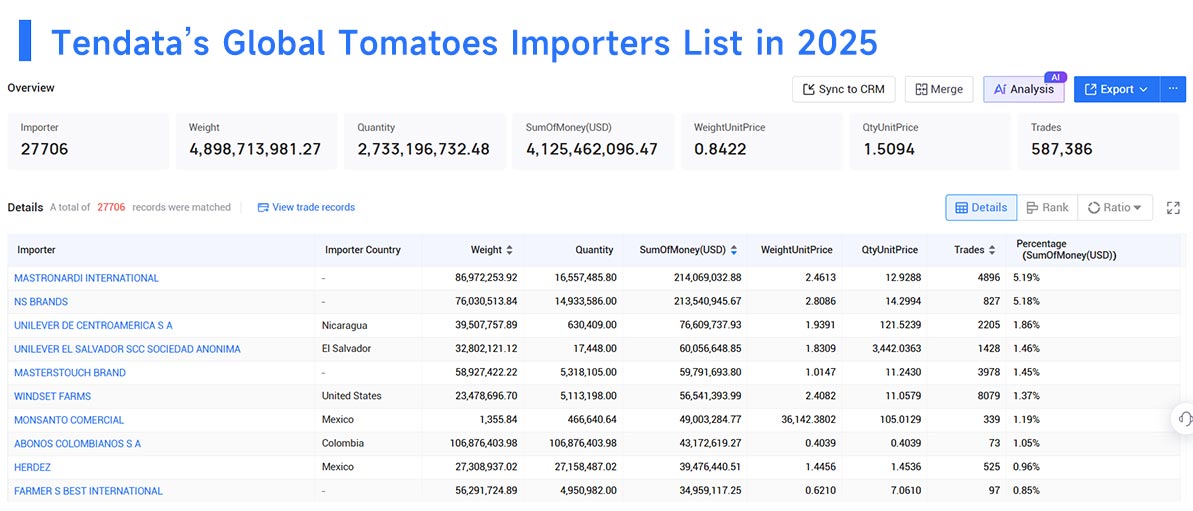
Company-level import data can be particularly useful for exporters, suppliers and sourcing teams looking to move beyond broad market statistics. By analyzing individual importers, their purchasing activity, trade partners and shipment records, businesses can identify active buyers and develop more targeted international sales strategies.
Category
Leave Message for Demo Request or Questions