 Exhibition
 B2B Platforms
 Standalone Website
 Social Media
 Emails
The 7 Essential Dimensions of Client Due Diligence: Why Your Database Provider Matters - Tendata
 Trade Data Provider
 2026-08-06
You've found a promising buyer. Their website looks professional. They responded to your email. So you move forward.
Then, three months into the relationship, you discover they've been running on thin cash flow. Or their "business" is actually a shell company fronting for someone else. Or they've just switched suppliers and your product no longer fits their needs.
Due diligence isn't a luxury in B2B trade—it's the difference between landing a profitable customer and losing months to a bad account.
The challenge is that due diligence isn't one-dimensional. It's not just "are they real?" You need to understand seven distinct layers of their business before you commit resources to the relationship.

The 7 Core Dimensions of Client Due Diligence
1. Verify Baseline Information
Start here. Does the company actually exist as registered? Are their Chinese and English names consistent across documents? Is their business address real, or are they operating from a virtual office?
Check their equity structure. How many shareholders? Is there real operational depth, or is this a shell company with one person making all decisions?
This layer is about eliminating obvious risks: fake companies, misrepresented business addresses, undisclosed ownership changes. It sounds basic, but it catches problems before they become expensive.
2. Assess Financial Health
A company with a great website might be hemorrhaging money.
Dig into their annual revenue, profit margins, and payment capacity. Are they carrying unpaid invoices? Do they have a history of contract violations or delayed payments? Credit reports and third-party databases can reveal whether they're a financial risk.
This is where you avoid bad debt. A customer who can't pay isn't a customer—they're a problem.
3. Map Their Procurement Needs
What does this company actually need? What's their core business, and what role does purchasing play in it?
Identify their current suppliers. Understand their requirements around product quality, price range, and delivery timeline. The more precise your picture of their real needs, the more targeted your pitch can be.
This dimension turns you from a generic salesperson into a strategic partner who understands their constraints.
4. Understand Their Target Markets
Where does this company sell their products? Are they focused on domestic markets or export-heavy? What's their customer base like?
Understanding their market position tells you whether your product fits. A company focused on budget retail markets has very different needs than one serving premium industrial clients.
5. Research Their Reputation & Track Record
What do other suppliers say about them? Are there unresolved disputes, negative press, or industry complaints?
Talk to people who've worked with them. Check industry forums and associations. Reputation problems are usually visible if you look—you just have to know where to check.
6. Assess Supply Chain Stability
Is their current supplier matrix stable, or are they constantly switching vendors? Where are the pain points in their supply chain?
Companies with unstable supplier relationships are either difficult to work with or are actively seeking alternatives. Understanding which is which changes your approach entirely.
7. Map the Competitive Landscape
Who are their main current suppliers? Do they have geographic preferences in sourcing?
If they've always bought from the US and you're positioning China, you'll need to overcome that bias. If they're locked into a long-term contract, you need to know when that expires.
The Channels That Actually Work
If you're serious about due diligence, focus on these:
· Company Official Channels: Website, LinkedIn, Facebook. You'll find business descriptions, scope of work, current clients, and activity signals.
· Search Engines: Google a company name + relevant keywords. Public registration records, industry reviews, and media coverage surface quickly.
· Industry Platforms & Import-Export Data: B2B platforms show you company shops and reviews. Most importantly, customs import-export data shows actual purchasing patterns—volume, frequency, supplier relationships, price ranges. This is real market behavior, not marketing claims.
· Third-Party Credit Platforms: These provide credit ratings, financial statements, and delinquency records.
· Industry Networks: Talk to peers, suppliers, and competitors. Reputation is visible if you ask the right people.
The Traditional Problem: Too Many Sources, Too Much Time
Traditionally, due diligence means juggling multiple tools:
· Google searches for company registration and news
· LinkedIn for company profiles and decision-makers
· Social media for business activity signals
· B2B platforms to see if they have a shop or reviews
· Credit report databases for financial history
· Import-export databases if you have access
· Cold calls to industry contacts for reputation research
Each source gives you partial information. You're stitching together a patchwork picture, manually copying data between platforms, normalizing different formats. The process takes days.
And even after all that effort, you're probably missing something.
The Database Provider Advantage
Here's where a good database provider saves weeks of work.
Instead of switching between Google, LinkedIn, credit platforms, and industry sites, a comprehensive platform consolidates the research. The best database provider for international trade combines company registration data, financial information, import-export records, and decision-maker contact details in one interface.
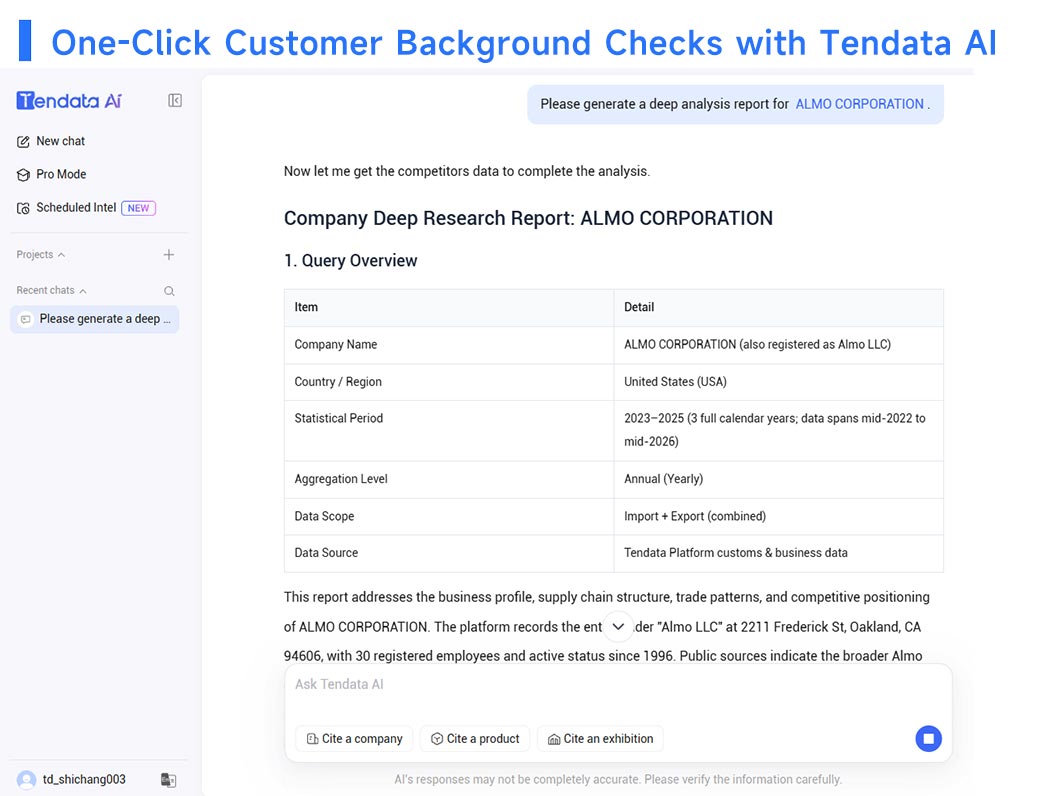
Take Tendata as an example. It functions as a single-point database provider that handles all seven due diligence dimensions:
· Baseline Information
Input a company name, and Tendata pulls registered business data: legal names (English and Chinese), business address, equity structure, company scale. You can immediately verify if the company is real or a shell operation.

· Procurement Pattern & Supply Chain Analysis
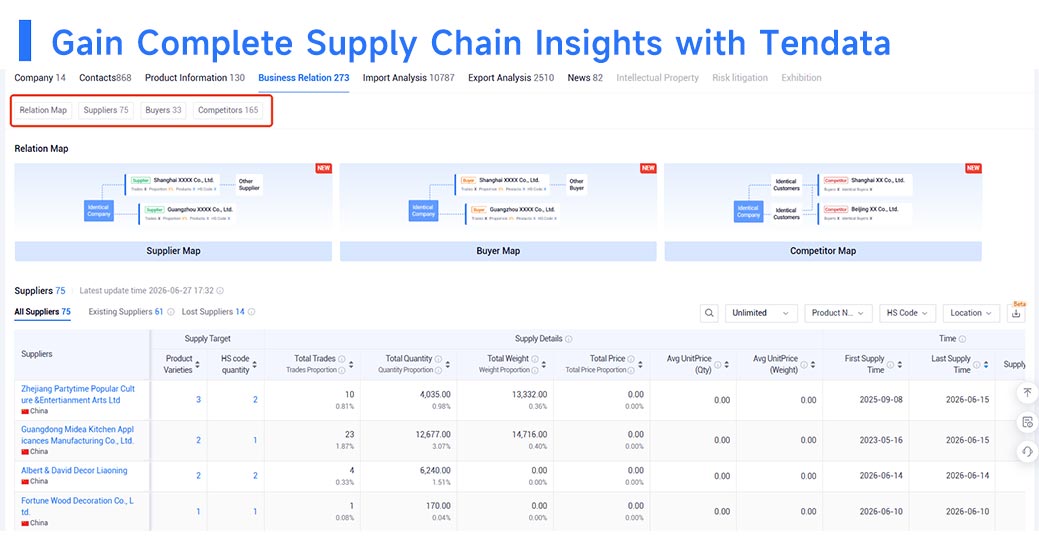
This is where the database provider's strength becomes obvious. Tendata's import-export data shows you actual purchasing history: what products they've bought, purchase frequency, order volumes, typical price points, ports of discharge, and—critically—which suppliers they've worked with.
You're no longer guessing at their needs. You're seeing their actual behavior.
Example: You discover they've imported similar products from three different suppliers over the past two years, with orders every 3-4 months. They have a supply chain gap. That's your entry point.
· Market Analysis
The platform shows their primary market regions and customer models. A company importing machinery for domestic factories has different needs than one importing for export-oriented assembly. Tendata's data reveals which.
· Competitive Intelligence
See who their current suppliers are, their sourcing geography preferences, and supplier switching patterns. If a company has worked with three Chinese suppliers in the last year, they're open to new Chinese vendors. If they've never sourced from China, you need a different pitch.
Without a database provider, complete due diligence on one prospect might take 4-6 hours across multiple platforms and manual research.
With Tendata or similar integrated database provider solutions, you're down to 20-30 minutes. The data is normalized, centralized, and oriented specifically toward trade and sourcing. No context-switching. No manual data entry.
Scale this across 50 prospects, and you're saving 150+ hours per month.
Category
Leave Message for Demo Request or Questions