 Exhibition
 B2B Platforms
 Standalone Website
 Social Media
 Emails
Turning International Trade Statistics into Market Opportunities - Tendata
 Trade Data Provider
 2026-08-19
International trade is constantly changing. Products move between countries, new suppliers enter established markets, import demand rises and falls, and competitive positions shift over time.
For businesses operating across borders, these changes are not always easy to see from sales experience alone. A market may appear attractive because of its large population, while actual import demand is declining. Another market may look relatively small but show rapid growth in a specific product category. This is where international trade statistics become valuable.
Instead of relying only on assumptions, companies can use trade statistics to examine actual import and export flows, product demand, trading partners, growth rates, and changes in market structure. When analyzed correctly, this information can support decisions about where to sell, what products to prioritize, which markets to enter, and where competitive opportunities may exist.

What International Trade Statistics Can Tell You
International trade statistics generally describe the movement of goods and services between economies. Depending on the source, the available information may include:
- Import and export values
- Import and export volumes
- Trading partners
- Product categories and HS codes
- Trade balances
- Historical trends
- Market shares
- Growth rates
- Tariff information
- Country-level or regional trade flows
The important point is that a single number rarely tells the whole story.
For example, knowing that a country imported $500 million worth of a product is useful, but it does not necessarily mean the market is a good opportunity. Businesses also need to understand whether imports are increasing, which countries supply the market, whether demand is concentrated among a few suppliers, and whether the product category is expanding or shrinking.
This makes trade statistics more useful when several indicators are viewed together.
Turning Trade Statistics into Market Opportunities
The real value of international trade statistics is not simply knowing how much a country imports or exports. Businesses need to look at multiple indicators together to understand where demand is growing and where opportunities may exist.
A practical analysis can focus on several key areas:
- Market size and growth — Compare import values and volumes over multiple years to identify markets with stable or increasing demand.
- Product demand — Break overall trade data down by product or HS code to find which categories are driving market growth.
- Supplier landscape — Examine the main supplier countries and changes in market share to understand the competitive structure.
- Purchasing changes — Monitor increases or decreases in import activity to identify emerging opportunities or potential market risks.
- Market potential — Consider demand, growth, competition, and supplier concentration together rather than selecting a market based on size alone.
For example, a country with the largest import volume may not be the best target if demand is declining and competition is highly concentrated. A smaller market with consistent growth and a more diverse supplier base may offer greater potential.
This approach turns international trade statistics from a collection of numbers into a practical framework for market selection, product planning, competitive analysis, and international expansion.
10 Free Platforms for International Trade Statistics
Free data sources are a useful starting point for companies conducting market research. However, different platforms have different geographic coverage, classifications, update schedules, and levels of detail.
Here are 10 additional platforms worth exploring.
1. WTO Stats
Website: https://stats.wto.org/
The World Trade Organization's statistics platform provides international trade statistics covering merchandise trade and commercial services. Users can filter data by economy, product or sector, and time period, with options to download data in Excel or CSV formats.
It is particularly useful when comparing trade performance across economies or examining long-term global trade trends.
2. World Integrated Trade Solution (WITS)
Website: https://wits.worldbank.org/
WITS, developed by the World Bank, combines international merchandise trade, tariff, and non-tariff measure data. Its country profiles and analytical tools can help users examine exports, imports, tariffs, and competitiveness indicators.
It is useful when trade statistics need to be considered alongside tariff and market-access conditions.
3. U.S. Census Bureau International Trade Data
Website: https://www.census.gov/foreign-trade/data/
The U.S. Census Bureau provides detailed U.S. import and export statistics, including data by HS classification, trading partner, geography, and time period. It also provides an International Trade API and USA Trade Online for customized queries.
This is especially useful for companies researching the U.S. market.
4. Canada Trade Data Online
Website: https://ised-isde.canada.ca/site/trade-data-online/en
Trade Data Online provides customized statistics for Canadian and U.S. trade in goods with more than 200 countries. Users can search by product or industry and analyze imports, exports, trade balances, and potential markets.
It can be useful for companies evaluating North American trade opportunities.
5. Brazil Comex Stat
Website: https://comexstat.mdic.gov.br/pt/home
Comex Stat is Brazil's official foreign trade statistics system. It is free to use without registration and allows users to analyze Brazilian imports and exports with detailed filters. The system provides data dating back to 1997 and supports data extraction in CSV and spreadsheet formats.
For companies interested in Latin American markets, Brazil's trade statistics can provide a useful view of product demand and trading partners.
6. Australian Trade Statistics
Website: https://www.dfat.gov.au/trade/trade-and-investment-data-information-and-publications/trade-statistics
The Australian Department of Foreign Affairs and Trade publishes statistics covering Australia's trade in goods and services, including country and commodity data. Its merchandise trade statistical tables provide detailed historical data and product classifications.
This can be useful when analyzing Australia's import sources, export markets, and commodity-level trade structure.
7. Data México
Website: https://www.economia.gob.mx/datamexico/
Data México provides visualized trade information using data from sources including INEGI and Banco de México. Users can examine Mexican imports and exports by country, product, state, and time period.
Its visualization-based format makes it useful for quickly understanding Mexico's trade structure and regional differences.
8. Taiwan Trade Statistics
Website: https://publicinfo.trade.gov.tw/cuswebo/FSCE000F/FSCE000F?menuURL=FSCE000F
Taiwan's International Trade Administration provides trade statistics sourced from the Customs Administration. Users can analyze import and export values by country, product, period, and other dimensions, with downloadable formats including XLS and PDF.
For electronics, machinery, components, and other manufacturing-related industries, this can be a valuable regional data source.
9. Argentina Foreign Trade Statistics
Website: https://comex.indec.gob.ar/
Argentina's INDEC provides a foreign trade query system covering imports and exports by product and trading partner. The system allows users to select periods, products, origin countries, and destination countries to generate customized results.
It can help companies studying Argentina's product demand and international trade relationships.
10. Observatory of Economic Complexity
Website: https://oec.world/en/
The Observatory of Economic Complexity provides interactive global trade visualizations that help users explore trade relationships, product structures, and economic complexity. It is particularly useful for turning large amounts of trade information into easier-to-understand visual patterns.
For early-stage market research, visualization can make it easier to identify structural changes that may be difficult to notice in raw datasets.
Why Free Trade Statistics Are Useful but Not Always Enough
Free international trade statistics are extremely useful for the first stage of research.
A company can use them to answer questions such as:
- Which countries import my product?
- How large is the market?
- Is demand increasing or declining?
- Which countries are the major suppliers?
- How has the trade balance changed?
- Which product categories are growing fastest?
However, most public trade statistics are designed to describe trade flows, not individual commercial relationships.
For example, a free database may show that a country imported thousands of tons of a particular product. But a sales team may still need to know:
- Which companies made those purchases?
- How often did they buy?
- Who are their existing suppliers?
- Has their purchasing volume increased?
- What other products do they purchase?
- Are there newly active buyers in the market?
This is the gap between understanding a market and acting on a market opportunity.
How Tendata Adds a Commercial Layer to Trade Statistics
Tendatatakes trade data analysis one step further by connecting trade flows with company-level purchasing information and analytical tools.
Instead of stopping at questions such as "Which country imports this product?", businesses can investigate the companies, purchasing patterns, suppliers, competitors, and market changes behind those trade flows.
Three customer cases illustrate how this approach can translate data into business decisions.
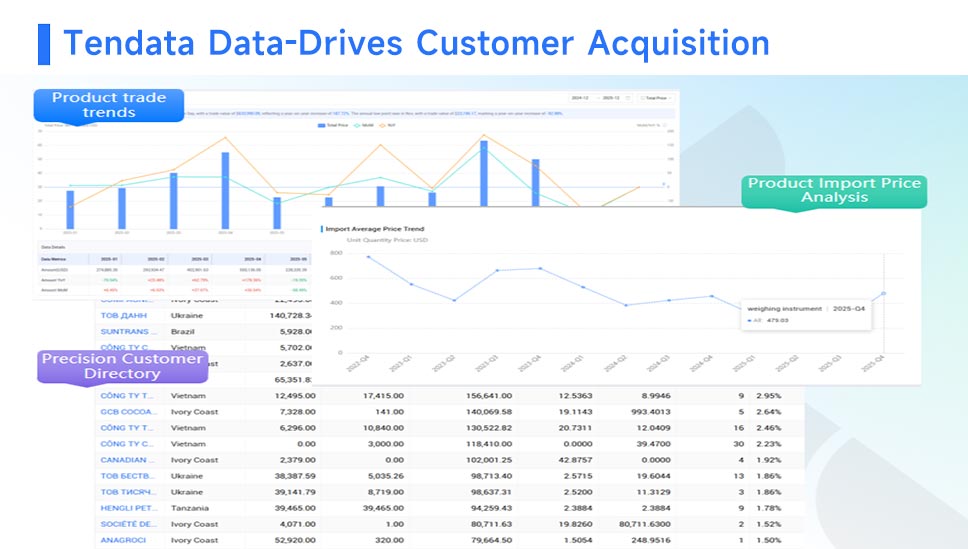
1. Turning Experience-Based Customer Acquisition into Data-Driven Decisions
Changzhou Lilang Electric Appliance Co., Ltd. specializes in industrial weighing instruments, including floor scales, truck scales, and platform scales, with products exported to markets across Europe, America, Asia, and Africa.
The company faced challenges in traditional customer acquisition and increasingly needed a more systematic way to understand customer demand.
First, analyze purchasing behavior. Instead of relying only on previous sales experience, Tendata iTrader was used to examine global purchasing behavior and identify potential customer demand and cross-selling opportunities.
Second, identify potential customers more precisely. Trade data can help the company screen companies with relevant purchasing activity and focus sales efforts on customers with stronger matching potential.
Third, continuously monitor demand changes. By tracking customer demand and market movements, the company can respond more quickly to changes and use data to support product and customer strategies.
The case demonstrates how international trade statistics can move from historical reference data toward an ongoing decision-making tool.
>>> Get a Free Demo from Tendata <<<
2. Using Existing Customer Data to Increase Order Opportunities
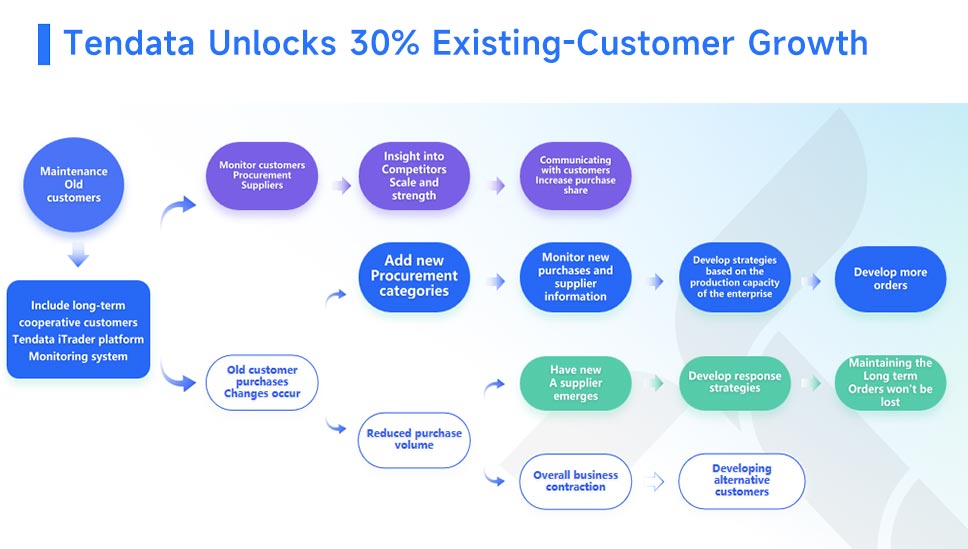
Zhuzhou Diamond Cutting Tools Co., Ltd. supplies cemented carbide cutting tools used across industries such as machine tools and automotive manufacturing.
The company wanted to better maintain existing customer relationships while responding to increasing competitive pressure.
Tendata's approach focused on three areas.
First, monitor existing customers and procurement changes. Tracking customer purchasing activity can reveal whether order volumes are increasing, declining, or shifting toward different product categories.
Second, understand competitors and suppliers. By monitoring procurement suppliers and competitor activity, the company can gain a clearer picture of changes in customer purchasing decisions and market competition.
Third, respond before customer demand is lost. When a customer's purchasing volume decreases or a new supplier appears, the company can investigate the reason and develop an appropriate response strategy.
According to the customer case presented by Tendata, this data-driven approach helped expand the share of existing customers, with orders increasing by 30% year over year.
The key lesson is that international trade statistics are not only useful for finding new markets. They can also help companies protect and expand the value of customers they already have.
>>> Get a Free Demo from Tendata <<<
3. Helping Sales Teams Move from Passive Leads to Targeted Opportunities
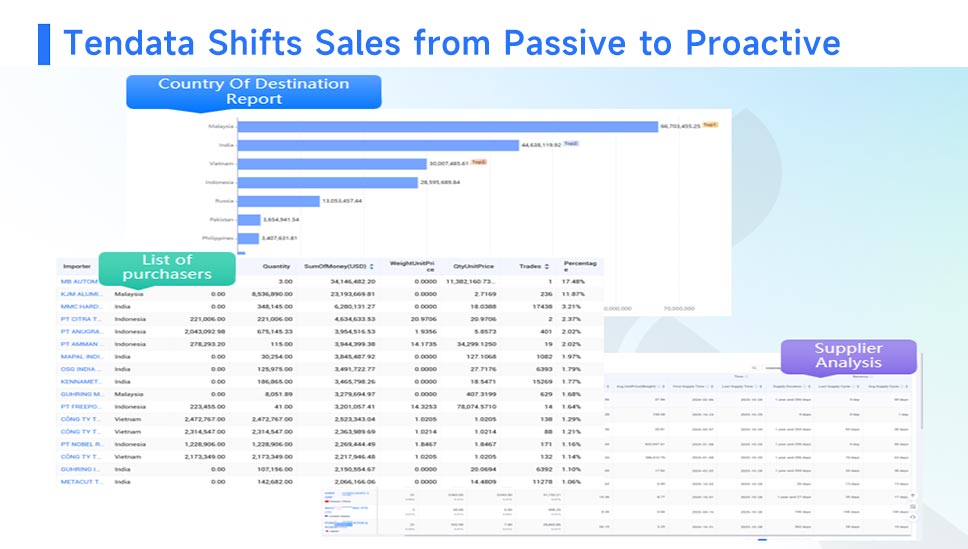
Changzhou Xutifeng Tools Co., Ltd. specializes in the design, development, manufacturing, and sale of end mills, drills, thread milling cutters, boring tools, and reamers.
As competition increased, the company needed to find new markets while improving the efficiency of customer acquisition.
First, identify high-potential markets. Tendata iTrader can be used to compare purchasing activity across countries and identify regions with stronger demand growth.
Second, move beyond passive inquiry-based sales. Instead of waiting for customers to send inquiries, sales teams can analyze purchasing records and identify companies that are already buying similar products.
Third, improve outreach efficiency. Customer purchasing information can help sales teams segment prospects and prioritize companies with stronger purchasing relevance, making communication more targeted.
The customer case highlights how digital tools can change the way sales teams approach international business — from waiting for opportunities to actively identifying them.
>>> Get a Free Demo from Tendata <<<
The Real Value of International Trade Statistics
International trade statistics are not simply numbers showing how much one country imports or exports.
When analyzed over time and across products, countries, suppliers, and trade relationships, they can reveal how markets are changing.
For exporters, the value may come from discovering an emerging destination.
For manufacturers, it may reveal changes in product demand.
For sales teams, it may help identify companies with active purchasing behavior.
For business leaders, it can provide an evidence-based foundation for decisions that were previously driven mainly by experience.
Free platforms are a strong starting point for understanding the global trade landscape. But when the goal shifts from "Where is demand?" to "Which companies can I actually sell to?", more detailed company-level trade intelligence becomes increasingly important.
Tendata helps bridge this gap by combining international trade data with customer, competitor, market, and purchasing analysis, allowing businesses to move from broad trade statistics to more targeted commercial decisions.
In global trade, the biggest advantage is not simply having more data. It is knowing which data matters, what it means, and what action should come next.
Category
Leave Message for Demo Request or Questions