 Exhibition
 B2B Platforms
 Standalone Website
 Social Media
 Emails
How to Find the Email Address of Overseas Procurement Managers in International Trade?
 Trade Data Provider
 2026-09-30
If you work in international trade, one of the most practical questions is:
How do you find the email address of the person actually responsible for purchasing?
The answer usually comes down to three approaches:
1. Research the company's website
2. Find the right person on LinkedIn and identify the company's email pattern
3. Use AI tools to match companies and contacts at scale, then verify the information
Why does this matter?
Because your cold emails may not be failing because your product or message is bad. They may simply be going to the wrong inbox.
An email sent to [email protected], [email protected], or [email protected] may be handled by a receptionist, customer service team, or general sales inbox rather than the person responsible for sourcing and purchasing.
Finding an email address is not the same as finding the right customer.
The goal is to find the right email address for the right person.
1. Start With the Company's Website
When you first discover a potential customer, the company website is usually the easiest place to start.
Look at pages such as:
· Contact Us
· About Us
· Our Team
· Management
· Company Profile
· News
· Products
· Careers
Some companies publish employee names, departments, or direct contact information on their websites.
However, the bigger value of website research is not necessarily finding an individual email address.
It is understanding who the company is.
Before contacting a potential buyer, try to understand:
· What products does the company sell?
· Which markets does it serve?
· Is it a manufacturer, distributor, importer, or retailer?
· How large is the business?
· What brands does it represent?
· Has the company recently expanded?
· What products or markets appear to be its current focus?
This information can later become the foundation for a more relevant sales email.
In many cases, however, the website only provides a general email address.
That's normal.
Don't expect the company website to give you everything you need in one step.
2. Use a Trade Data Website to Identify Relevant Buyers
Before spending time looking for a procurement manager's email, it is worth asking a more fundamental question:
Is this company actually a relevant buyer?
A company may look like a potential customer based on its website, industry, or product catalog. But that does not necessarily mean it actively purchases the products you sell.
This is where a trade data website can add another layer of research.
Instead of relying only on publicly available company information, you can investigate import activity, product categories, sourcing countries, purchasing frequency, and other trade-related signals.
For example, if you sell industrial components, a trade data website may help you identify companies that have actually imported similar products rather than simply listing the product on their website.
This makes the prospecting process more focused:
Potential Company → Purchasing Activity → Relevant Buyer → Decision-Maker → Contact Information
Trade data does not replace company research, but it can help determine which companies deserve deeper research in the first place.
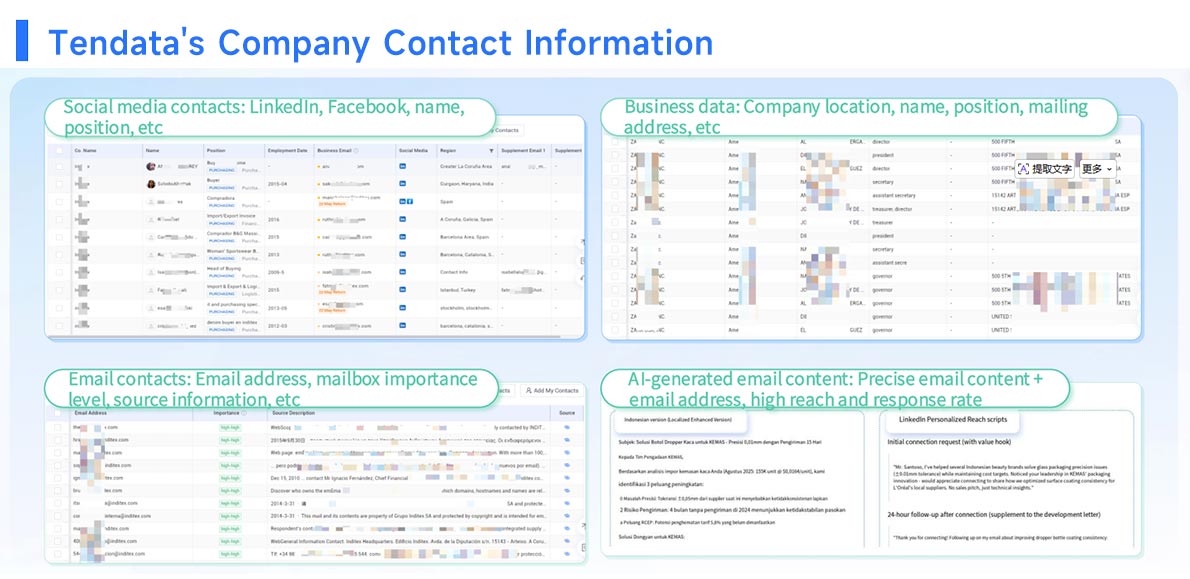
>>Use Tendata to find Company Contacts<<
3. Find the Right Person on LinkedIn
Once you have identified a relevant company, LinkedIn can help you find the people working there.
Start by searching for the company and opening its LinkedIn page.
Then look through the employee list and search for relevant job titles.
Depending on the industry, useful titles may include:
· Procurement Manager
· Purchasing Manager
· Sourcing Manager
· Supply Chain Manager
· Procurement Director
· Purchasing Director
· Head of Procurement
· Supply Chain Director
· Product Manager
· Operations Manager
For smaller companies, the person responsible for purchasing may simply be the owner, general manager, or CEO.
There is also an important point that many exporters overlook:
B2B purchasing decisions are rarely made by one person alone.
For technical products, machinery, industrial equipment, or complex solutions, technical, operations, finance, and management teams may all influence the final decision.
So don't automatically assume that the person with "Procurement" in their title is the only person worth contacting.
Once you identify the right person, you have their full name and company information.
LinkedIn may not display their email address directly, but you can sometimes identify the company's email pattern from publicly available company information.
For example, a company may use a format such as:
[email protected]or[email protected]
The exact format varies from company to company.
This can help you form a potential business email address—but do not assume that a guessed address is valid.
That leads to the next step.
4. Verify the Email Before Sending
This step is easy to overlook, but it is critical for cold outreach.
An email address that looks correct does not necessarily exist.
For example, you might identify:John Smith → [email protected]
The format may look perfectly reasonable, but the mailbox could be inactive, incorrect, or nonexistent.
Before sending a large number of emails, use an email verification tool to check the address.
Why?
Because repeated delivery failures can hurt your email-sending reputation.
A high bounce rate can affect future deliverability, meaning that even valid emails may have a harder time reaching the recipient's inbox.
A simple workflow is:
Find Contact → Identify Email Pattern → Verify Email → Send
For larger outbound campaigns, email verification should be treated as part of the prospecting process rather than an optional extra step.
5. Use AI to Find Contacts at Scale
The first few steps work well when you're researching a small number of companies.
But what happens when you need to research hundreds or thousands of potential buyers?
Doing everything manually can take a huge amount of time.
You may need to:
· Find the company
· Open the website
· Understand the business
· Check its trade activity
· Search LinkedIn
· Identify relevant employees
· Determine their roles
· Find potential contact information
· Verify the email
· Research the company's purchasing activity
· Prepare a personalized message
This is where AI-powered sales intelligence tools can make the process more scalable.
For example,Tendata AIcan use Tendata's global import/export company and trade data to identify companies that match your target product or market and help identify relevant decision-makers and available business contact information.
As a trade data website and global trade intelligence platform, Tendata connects company information with import/export data, helping sales teams move from broad company discovery to more targeted buyer research.
Instead of manually researching one company at a time, sales teams can use Tendata AI to accelerate the initial prospecting process.
Tendata combines company intelligence, global trade data, and AI analysis to support tasks such as:
· Buyer and importer discovery
· Company profiling
· Trade record analysis
· Decision-maker identification
· Contact research
· Customer due diligence
· Personalized outreach
This is particularly useful when your target market contains hundreds or thousands of potential companies.
However, AI should not eliminate human verification.
The larger the prospecting campaign, the more important it becomes to verify important contact information before launching outreach.
6. Don't Stop After Finding the Email
Finding the correct email address is only one part of customer development.
A common mistake in international trade is to spend 80% of the effort finding contact information and only 20% understanding the company.
The better approach is the opposite.
Once you identify a potential buyer, spend a few minutes researching the business before sending your first email.
Look at:
· Main products
· Target markets
· Business model
· Existing suppliers
· Purchasing countries
· Purchase frequency
· Recent purchasing changes
· Product categories
· Company developments
Trade intelligence can make this research much more specific.
For example, if you discover that a potential buyer has been importing a particular product regularly, you already have a more meaningful reason to contact them than simply saying:
"We are a professional manufacturer of XXX."
A trade data website can help you investigate questions such as:
· What products does the company purchase?
· How frequently does it purchase?
· Where does it source from?
· Has its purchasing volume changed?
· Does it work with multiple suppliers?
· Has its sourcing pattern changed recently?
With Tendata AI, sales teams can use historical trade records and company intelligence to conduct this type of background research before outreach.
The objective is not to mention every piece of information in the email.
It is to understand why this particular company might be relevant.
7. Personalize the Email Based on What You Find
Once you have the right person and have researched the company, your email can become much more specific.
Instead of:
"Dear Sir/Madam,
We are a professional manufacturer and exporter of..."
you can connect your message to the prospect's business.
For example:
"Hi John,
I noticed that your company has been sourcing [product category] for the European market. We work with distributors in similar markets and recently expanded our production capacity for this product line. I thought it might be relevant to your sourcing team."
The difference is not simply personalization of the recipient's name.
The message has a reason for being sent to that particular company.
That is what makes research valuable.
8. A More Efficient Workflow for International Trade Prospecting
For companies developing overseas customers at scale, a practical workflow looks like this:
Target Market → Identify Potential Buyers → Check Trade Activity → Find Decision-Makers → Research Contact Information → Verify Email → Analyze Purchasing Activity → Personalize Outreach → Follow Up
Each step solves a different problem.
Trade data helps answer:
Who is actually buying?
Company research helps answer:
What does this company do?
LinkedIn and professional networks help answer:
Who is involved in the decision?
Email verification helps answer:
Can I actually reach this person?
AI helps answer:
How can I do all of this faster?
And the final sales conversation still depends on human judgment.
Final Thoughts
Finding overseas procurement contacts is not simply an exercise in collecting email addresses.
The real goal is to connect the right company, the right person, the right contact information, and the right reason for reaching out.
A practical process is:
Company Research → Trade Data → LinkedIn → Decision-Maker → Email Verification → Customer Research → Personalized Outreach
A trade data website can help identify companies with relevant purchasing activity before salespeople invest time in finding individual contacts.
For larger-scale customer development, Tendata and Tendata AI can help connect trade data, company intelligence, decision-maker research, contact information, and AI-assisted analysis in a more structured workflow.
The goal is not simply to find more email addresses.
It is to find the right people at the right companies—and approach them with a relevant reason to start a conversation.
And remember one final point:
Finding the email is not the end of prospecting. It's the beginning of a better conversation.
Category
Leave Message for Demo Request or Questions