 Exhibition
 B2B Platforms
 Standalone Website
 Social Media
 Emails
Can Export Import Data Help You Find the Right Customers? - Tendata
 Trade Data Provider
 2026-08-26
If you work in international trade, you have probably faced the same challenge: sending dozens of sales emails every day, connecting with hundreds of prospects on LinkedIn, yet receiving only a handful of responses. In today’s competitive global market, more companies are turning to export import data to identify potential buyers, understand purchasing behavior, and improve their customer development strategies.
The problem is often not a lack of effort, but a lack of precision in targeting the right prospects.
That is why more and more businesses are turning to export import data. It is more than just a list of companies. It can help businesses identify purchasing needs, understand trading patterns, and discover potential buyers.
So, what value can export import data really bring to your customer development strategy?

1. Why Is It Becoming Harder to Find the Right Customers Through Social Media Alone?
Platforms such as LinkedIn and Facebook remain important channels for international customer acquisition.
Their biggest advantage is clear: they allow sales teams to connect directly with purchasing managers, business owners, and other key decision-makers. The barrier to entry is relatively low, making social media suitable for proactive outreach and brand exposure.
However, there is one major limitation: you can see the person, but you cannot necessarily see the demand behind them.
For example, a purchasing manager may be highly active on LinkedIn, but that does not necessarily mean the company is currently looking for new suppliers. Similarly, a company may regularly publish product-related content without having any immediate purchasing needs.
As a result, sales representatives can spend a significant amount of time sending connection requests and messages, while response rates remain unpredictable.
The underlying issue is a lack of insight into actual purchasing demand.
In simple terms, social media helps you find the people, while export import data helps you identify who is actually buying.
2. What Is the Real Value of Export Import Data?
Many people view trade data simply as a collection of import and export records. In reality, the value of export import data lies in its ability to help businesses understand and reconstruct a company's actual purchasing behavior.
1. Gain Visibility into Actual Purchasing Activity
A company's website may tell you what products it sells, but export import data can provide insights into what the company is actually purchasing.
Import records can help businesses identify whether a company regularly imports a particular product, how frequently it makes purchases, and which countries its products are sourced from.
Compared with basic company profiles, these insights can provide a stronger foundation for identifying potential customers.
2. Identify Target Customers More Efficiently
When you are dealing with thousands of companies, the biggest challenge is not necessarily finding more prospects — it is identifying which ones are worth pursuing.
With export import data, businesses can filter potential customers based on product names, HS codes, countries and regions, purchase frequency, import volumes, and other criteria.
This makes it possible to narrow down a large pool of companies and focus on active importers that are more closely aligned with your target market.
3. Gain Insights into Market and Competitive Landscape
Beyond customer acquisition, export import data can also provide valuable insights into market trends and competitive dynamics.
For example:
· Which countries are importing more of a particular product?
· Which suppliers are a potential customer's current partners?
· Which markets are competitors actively entering?
These insights can support not only customer acquisition, but also market selection, competitive analysis, and broader business strategy.
3. Why Do Some Businesses Still See Limited Results After Using Trade Data?
Some businesses invest in trade data but find that their customer development results do not improve as much as expected. The issue is often not the data itself, but how the data is used.
Common challenges include:
· Having import records but not knowing which prospects should be prioritized;
· Understanding individual trade records but struggling to identify broader purchasing patterns;
·Exporting large numbers of company leads but continuing to rely on mass outreach, resulting in limited conversion.
This is where data analysis becomes critical.
How CanTendata AIMaximize the Value of Trade Data?
>>Get a free demo about Tendata AI<<
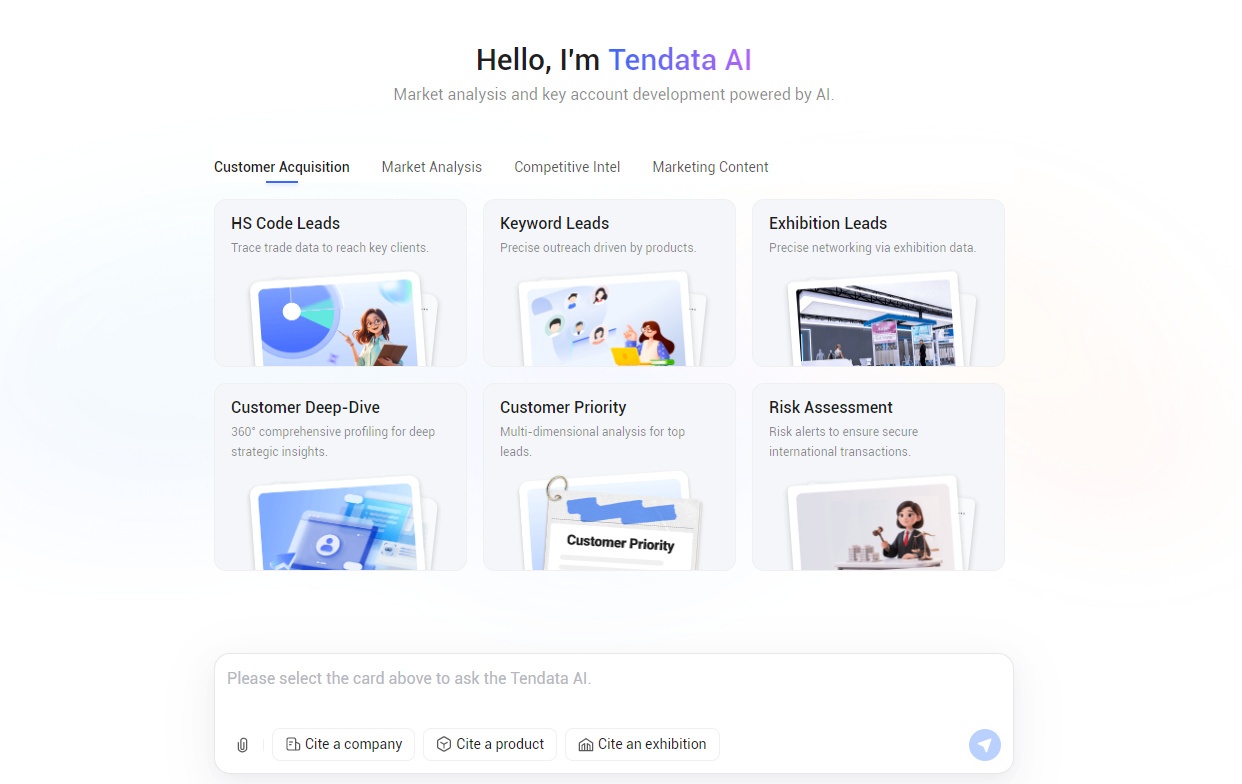
To address the challenges of traditional data analysis, Tendata AI brings greater intelligence and efficiency to the use of export import data.
By analyzing factors such as a company's trade records, purchasing frequency, and product relevance, Tendata AI can help identify high-potential prospects, generate insights into purchasing profiles and trade trends, and turn complex trade data into actionable sales leads.
This allows sales teams to spend less time manually screening large amounts of information and more time engaging with prospects that are genuinely worth pursuing.
4. What Can Export Import Data Really Do for International Customer Development?
It is important to understand that export import data cannot replace the sales process itself.
Closing a deal still depends on factors such as product competitiveness, pricing, communication, and relationship building. However, data can make the first and arguably one of the most important steps — identifying the right prospects — much more precise.
For trading Companies, Tendata provides more than just export import data. It offers a comprehensive set of tools to support customer development, including:
Global trade data: Identify active importers and potential buyers more efficiently;
Company profiles, purchasing records, and contact information: Gain a more comprehensive understanding of target companies;
AI-powered customer analysis: Evaluate potential customers and improve lead-screening efficiency;
Data-driven customer development: Move from broad, untargeted outreach to more precise and efficient prospecting.
Conclusion:
Effective international customer development is not about collecting as many company names as possible. It is about identifying companies with genuine purchasing needs.
The value of export import data is not to replace sales professionals, but to give every outreach effort a clearer direction.
At Tendata, our goal is to help businesses turn data into actionable insights — and ultimately, turn those insights into real business opportunities.
Category
Leave Message for Demo Request or Questions