 Exhibition
 B2B Platforms
 Standalone Website
 Social Media
 Emails
How Trade Data Analysis Helps Businesses Make Smarter Global Trade Decisions - Tendata
 Trade Data Provider
 2026-08-18
International markets can look very different from one industry to another. A market may have strong demand but intense competition, while another may offer promising opportunities but require a different product strategy.
For companies operating across borders, making these decisions based only on experience, trade shows, or general online searches can be difficult. This is where trade data analysis can provide a more practical source of business intelligence.
By analyzing actual import and export activities, companies can understand market demand, identify active buyers, compare suppliers, monitor competitors, and spot changes in customer purchasing behavior.
More importantly, trade data can help turn these findings into specific decisions about where to sell, who to approach, what to offer, and how to manage supply chains.

What Trade Data Analysis Can Help Businesses Understand
Trade data contains information about products, countries, importers, exporters, shipment activity, prices, quantities, and trading relationships.
When these data points are analyzed together, businesses can gain insights that are difficult to obtain through conventional market research.
For example, an exporter can compare import volumes across countries to find markets with stronger demand. A manufacturer can study competitor shipments to understand how other suppliers are positioning themselves. A sales team can identify companies that are actively purchasing a particular product instead of building prospect lists from general business directories.
Trade data analysis can also reveal changes over time.
A sudden increase in imports may signal growing demand. A change in suppliers could indicate an opportunity for a new vendor. A decline in purchasing activity may suggest that a customer or market requires a different sales strategy.
These insights make trade data useful not only for market research but also for customer development, competitive analysis, and supply chain planning.
10 Free Platforms for Trade Data Research
Businesses can start their international market research with a range of free government and international trade databases. These platforms generally provide aggregated trade statistics rather than detailed company-level intelligence, but they are useful for understanding global trade flows.
1. UN Comtrade
Website: https://comtradeplus.un.org/
UN Comtrade provides international merchandise trade statistics reported by countries and territories. Users can research imports and exports by product, trading partner, reporting country, and trade flow.
2. U.S. Census Bureau International Trade Data
Website: https://www.census.gov/foreign-trade/data/index.html
The U.S. Census Bureau provides official U.S. import and export statistics covering products, countries, ports, and other trade categories. Historical datasets and APIs are also available for further analysis.
3. UK Office for National Statistics
Website: https://www.ons.gov.uk/businessindustryandtrade/internationaltrade
The UK Office for National Statistics provides official statistics covering international trade in goods and services, allowing businesses to study UK imports, exports, and international trading relationships.
4. Japan Customs Trade Statistics
Website: https://www.customs.go.jp/toukei/info/index_e.htm
Japan Customs provides official trade statistics that can be searched by commodity and country. Businesses can use the data to examine Japanese import and export activity and historical trade patterns.
5. K-Stat
Website: https://stat.kita.net/
K-Stat is operated by the Korea International Trade Association and provides Korean and international trade statistics covering products, countries, and trade flows.
6. Australian Bureau of Statistics
Website: https://www.abs.gov.au/statistics/economy/international-trade
The Australian Bureau of Statistics provides international merchandise trade statistics covering Australia's imports, exports, commodities, and trading partners.
7. Statistics Canada International Trade
Website: https://www.statcan.gc.ca/en/subjects-start/international_trade
Statistics Canada provides international merchandise trade data and tools for researching Canadian imports and exports by trading partner, commodity, and other categories.
8. New Zealand Trade Statistics
Website: https://www.stats.govt.nz/topics/international-trade
Stats NZ provides official international trade statistics covering New Zealand's imports, exports, products, and trading partners.
9. India TradeStat
Website: https://tradestat.commerce.gov.in/
India TradeStat provides official Indian import and export statistics that can be analyzed by commodity, country, and other trade dimensions.
10. ITC Trade Map
Website: https://www.trademap.org/
ITC Trade Map provides international trade statistics covering products, countries, and trading partners. It can be used to compare markets and examine changes in global trade flows.
These free resources are useful for understanding broad market trends. However, companies that want to connect trade statistics with specific customers, competitors, and supply chains may need more detailed trade intelligence.
How Tendata Turns Trade Data Analysis Into Business Opportunities
Tendatacombines global trade data with company information, shipment records, customer intelligence, competitor insights, and supply chain data.
The value of the platform becomes clearer when looking at how different companies have applied these capabilities to real business challenges.
Polymeric Technology Sdn Bhd Turns Domestic Success Into Export Opportunities
Polymeric Technology Sdn Bhd specializes in high-quality coating resins for decorative, automotive, and protective coating applications.
The company wanted to expand its international business but faced several challenges. Its existing market was becoming increasingly saturated, while its sales model depended heavily on agents. This limited direct access to end customers and made it harder to respond quickly to changes in market demand.
Tendata helped the company approach international expansion through data rather than relying solely on traditional market research.
>>> Get a Free Demo from Tendata <<<
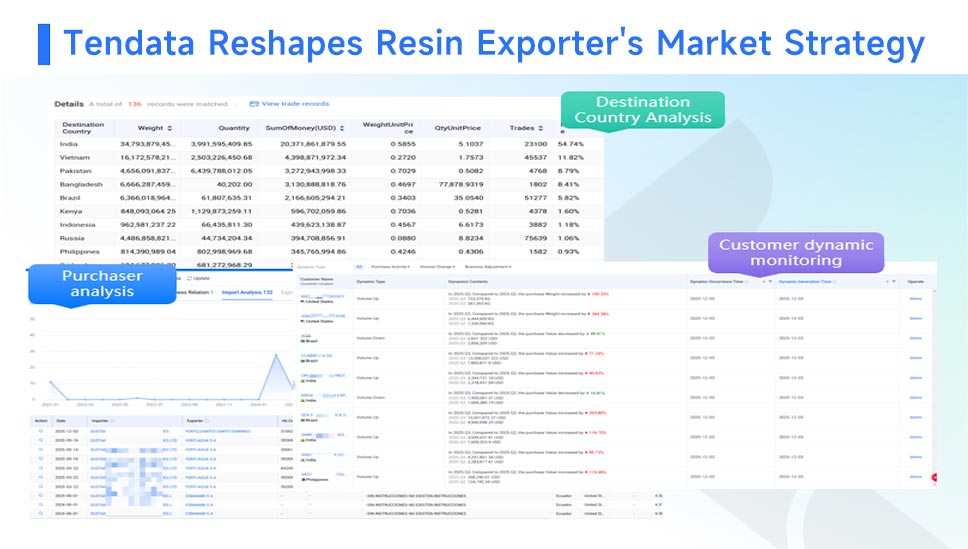
Identify Markets With Stronger Potential
The company used Tendata's import volume, pricing, and competitor insights to evaluate potential markets.
By analyzing trade flows, the team could identify promising regions such as India, Southeast Asia, and Africa and better understand differences in market demand.
This information provided a stronger basis for adapting product offerings to local regulatory, infrastructure, and market requirements.
Find Active Buyers Instead of Relying Only on Agents
The company's dependence on agents also made it difficult to proactively reach end customers.
Using Tendata's Top Importer lists and shipment records, the company could identify active buyers in target markets and initiate more targeted outreach.
At the same time, market and competitor information could be shared with distributors to help them understand local competition and improve their sales effectiveness.
Monitor Demand and Find Adjacent Opportunities
High-value equipment and industrial products may have relatively long purchasing cycles, making revenue less predictable.
Tendata helped the company monitor import patterns and changes in market demand. These signals could then be used to adjust product strategies and explore adjacent market segments.
The case demonstrates how trade data analysis can help a company move from primarily domestic sales toward a more systematic international expansion strategy.
Jas Global Industries Uses Trade Data to Build a $55 Million Business
Founded in 1998, Jas Global Industries develops chemical solutions for the fertilizer, mining, and water treatment industries.
The company had already established a strong business foundation but faced several challenges as it looked for additional growth.
Expanding from established markets such as the Middle East into regions including Southeast Asia required significant research. Traditional approaches such as trade shows and basic Google searches were time-consuming and did not always produce qualified opportunities.
>>> Get a Free Demo from Tendata <<<
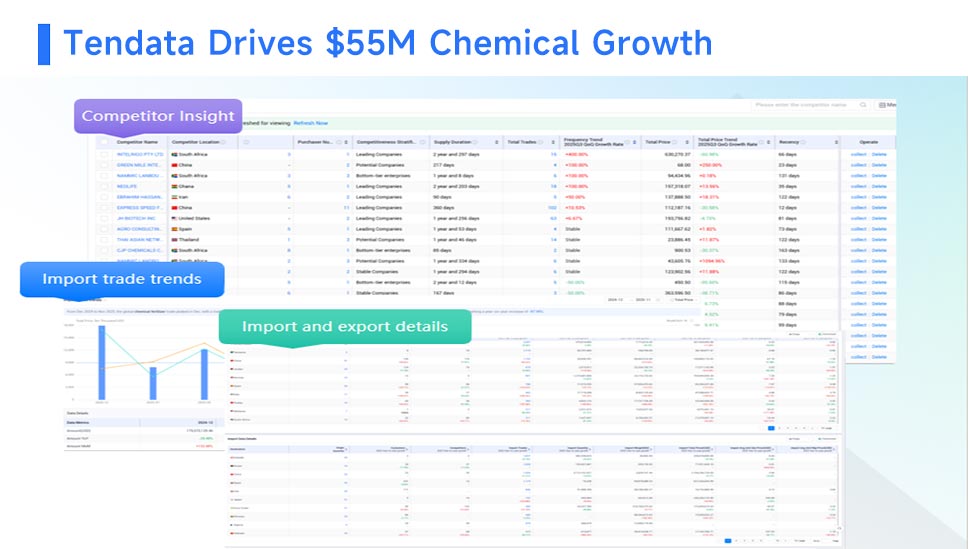
Find Real Buyers in New Markets
Jas Global Industries used Tendata's import and export records to identify buyers based on specific products and destination countries.
For example, the company could search for buyers of products such as phosphoric acid in markets including Brazil and Thailand.
Instead of relying on assumptions about which companies might need a product, the team could use actual trade activity to find businesses already participating in relevant transactions.
Compare Suppliers and Improve Negotiating Power
Intense competition had reduced the company's gross margins from around 25% to approximately 8–10%.
Finding lower-cost but reliable suppliers therefore became increasingly important.
Through Tendata, the company could analyze actual export prices, shipment volumes, and purchasing frequencies across different countries.
Comparing supplier activity in markets such as China and Thailand gave the company additional information when evaluating sourcing options and negotiating with suppliers.
Monitor Customers to Anticipate Demand
Many downstream customers, including fertilizer and ceramic manufacturers, have irregular production cycles. As a result, chemical purchasing can fluctuate significantly.
Tendata helped the company monitor customers' trade activity and identify purchasing signals, such as changes in raw material imports.
These signals could provide an early indication of changes in customer production, allowing the company to adjust sales and inventory strategies accordingly.
Through this data-driven approach, Jas Global Industries generated US$55 million in a single year, demonstrating how trade data analysis can support not only customer acquisition but also sourcing and demand planning.
Jianglang Technology Uses Digital Tools to Accelerate Overseas Development
Jianglang Technology Co., Ltd. is a manufacturing company with independent R&D, design, and precision processing capabilities. Its product portfolio includes control valves, control ball valves, control butterfly valves, diaphragm pumps, and other industrial products.
Approximately 35% of its products are exported to international markets.
However, the company faced a common challenge for manufacturers expanding overseas: insufficient access to reliable information about international market dynamics.
>>> Get a Free Demo from Tendata <<<
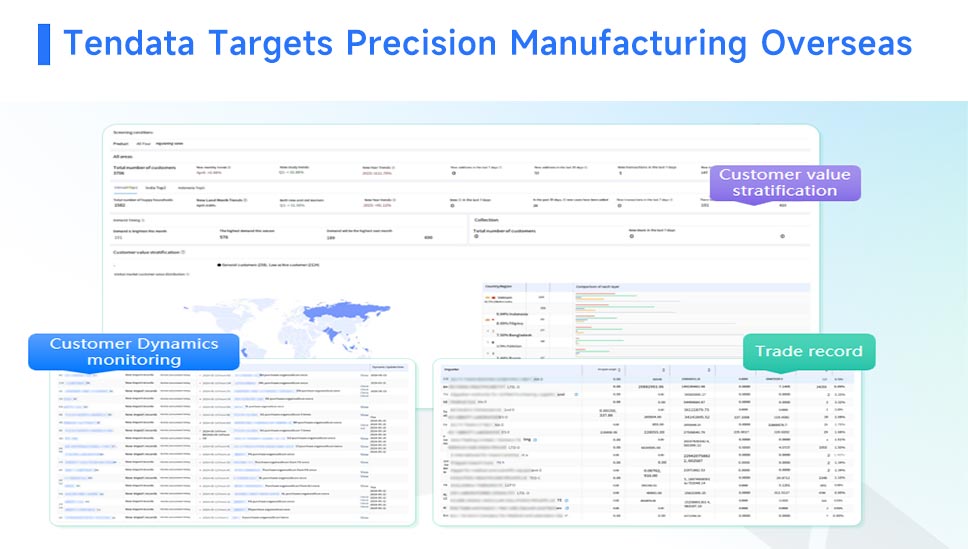
Understand Market and Supply Chain Structure
Jianglang Technology used Tendata to analyze the proportion of market purchasers and exporters.
This provided a clearer view of how real customers and supply chains were distributed and helped the company better understand its position within different markets.
Instead of relying only on general industry information, the company could use actual trade activity to examine market structures.
Build More Precise Customer Profiles
Another challenge was the lack of clear demand insights when developing marketing strategies.
Tendata helped Jianglang Technology build customer profiles and focus on medium and large-sized companies with established foreign trade activities.
This allowed the company to develop more targeted marketing strategies around customers with stronger potential instead of approaching a broad and relatively undefined audience.
Analyze Customer Supply Chains and Competitors
The company also needed better information about customers' actual purchasing power and supply chains.
By using Tendata to analyze customer supply chains and competitor information, Jianglang Technology could identify potential cooperation opportunities and better understand competitive relationships.
This helped the company strengthen its market development approach and increase its market share.
What These Cases Show About Trade Data Analysis
These three companies operate in very different industries, but their experiences reveal several common applications of trade data analysis.
For Polymeric Technology, the focus was finding new markets, identifying active buyers, and reducing dependence on traditional sales channels.
For Jas Global Industries, trade intelligence supported buyer discovery, supplier comparison, customer monitoring, and demand planning.
For Jianglang Technology, the priority was understanding market structure, building better customer profiles, and analyzing supply chains and competitors.
The common point is that none of these companies used trade data simply to collect statistics.
They used it to answer practical business questions:
- Where should we sell?
- Who should we approach?
- Which suppliers are worth considering?
- What are our competitors doing?
- When is a customer likely to need our products?
From Trade Data to Better Business Decisions
The amount of international trade information available to businesses continues to grow. Free databases can provide an excellent starting point for understanding imports, exports, products, and markets.
But raw data becomes much more valuable when it can be connected to specific companies and business activities.
Tendata helps businesses take this next step by combining global trade records with customer information, supplier intelligence, competitor insights, and market analysis.
For manufacturers, exporters, and international sales teams, this can turn trade data analysis from a research task into a practical part of customer development, market expansion, sourcing, and sales planning.
The goal is not simply to collect more trade data. It is to understand the signals behind the data and use them to make better decisions about markets, customers, suppliers, and growth opportunities.
Category
Leave Message for Demo Request or Questions