 Exhibition
 B2B Platforms
 Standalone Website
 Social Media
 Emails
World Import Export Data Guide for Smarter Global Market Research and Customer Acquisition - Tendata
 Trade Data Provider
 2026-08-20
In today’s globalized economy, businesses need more than product knowledge and traditional market research to compete internationally. World import export data provides a powerful way to understand how products move across borders, which markets are growing, what countries are importing specific products, and where potential business opportunities may exist.
For manufacturers, exporters, distributors, and international sales teams, analyzing world import export data can help answer critical questions: Which countries have the strongest demand for a product? Who are the major trading partners? Which markets are expanding? What products are competitors exporting? And how can companies turn market intelligence into qualified customer opportunities?
This guide explains what world import export data is, how to use it effectively, 10 free trade and customs data platforms, and how businesses can go beyond macro-level statistics with Tendata.

What Is World Import Export Data?
World import export data refers to international trade information that records the movement of goods between countries and regions. Depending on the data source, it can include information such as:
- Import and export values
- Import and export quantities
- Product descriptions
- HS codes
- Importing and exporting countries
- Trading partner countries
- Trade growth rates
- Market shares
- Product categories
- Tariff information
- Importer or exporter information
- Shipment or transaction records
Most official international trade databases provide aggregated statistics based on customs declarations and national statistical systems. For example, UN Comtrade aggregates detailed annual and monthly trade statistics by product and trading partner and covers approximately 200 countries, representing more than 99% of global merchandise trade.
However, not all world import export data is the same. Some platforms are designed for macroeconomic research, while others provide detailed shipment-level or company-level information.
This distinction is particularly important for businesses that want to use trade data not only to understand markets but also to find potential buyers.
10 Free Customs and Trade Data Platforms
Free platforms are excellent starting points for market research, trade trend analysis, and product-level demand assessment. However, their coverage and level of detail vary significantly.
1. UN Comtrade
Website: https://comtrade.un.org/
UN Comtrade is one of the most widely used sources for international merchandise trade statistics. It provides annual and monthly data by product and trading partner and covers approximately 200 countries.
Best for:
- Global market research
- HS-code analysis
- Country comparisons
- Long-term trade trends
- Academic and business research
Limitation: The data is primarily aggregated and does not provide a complete company-level buyer database.
2. ITC Trade Map
Website: https://www.trademap.org/
ITC Trade Map is developed by the International Trade Centre and is designed to help users analyze international trade flows, market demand, export performance, and competitive markets. Trade Map provides graphs, maps, and tables and supports monthly, quarterly, and yearly trade flows.
Best for:
- Market selection
- Product demand analysis
- Competitor-country analysis
- Trade-flow comparisons
Limitation: Many detailed functions require registration or paid access, and it is not primarily a shipment-level buyer database.
3. USITC DataWeb
Website: https://dataweb.usitc.gov/
USITC DataWeb provides public access to official U.S. import and export statistics. Users can query data by trade flow, time period, trading partner, product classification, and other parameters. The system can provide detailed product data down to the 10-digit HTS or Schedule B level where available.
Best for:
- U.S. import research
- U.S. export analysis
- HTS-code research
- Tariff-related analysis
Limitation: Its primary focus is the U.S. market.
4. Eurostat Comext
Website: https://ec.europa.eu/eurostat/
Eurostat’s Comext database provides detailed international trade in goods statistics for the EU, euro area, EU member states, and a number of non-EU countries. It includes recent and historical data, with monthly and annual downloadable datasets.
Best for:
- European market research
- EU import/export analysis
- Product-level research
- Historical trade analysis
Limitation: The platform is particularly valuable for EU-focused research rather than global company-level buyer discovery.
5. World Integrated Trade Solution (WITS)
Website: https://wits.worldbank.org/
WITS is a World Bank platform providing access to international merchandise trade, tariff, and non-tariff measure data. It allows users to explore imports, exports, trading partners, products, and tariff information.
Best for:
- Global trade analysis
- Tariff research
- Country comparisons
- Product-level trade analysis
Limitation: Custom analytical functions require registration, and the platform is focused on statistical and policy analysis rather than direct buyer acquisition.
6. WTO Tariff & Trade Data
Website: https://ttd.wto.org/en
The WTO Tariff & Trade Data platform provides official tariff and import data for more than 150 economies. Users can explore bilateral trade flows, tariffs, imports and exports, historical trends, and tariff actions.
Best for:
- Tariff research
- Bilateral trade analysis
- Import and export trends
- Trade policy research
Limitation: It is more suitable for macro-level trade and tariff analysis than company-level prospecting.
7. Observatory of Economic Complexity
Website: https://oec.world/
The Observatory of Economic Complexity, or OEC, is a visualization-focused platform that helps users explore trade flows between countries and products.
Best for:
- Trade visualization
- Product-country relationships
- Export structure analysis
- Economic complexity research
Limitation: The information is primarily aggregated and is not designed to provide detailed importer contact information.
8. Trade Statistics of Japan
Website: https://www.customs.go.jp/toukei/info/index_e.htm
Japan Customs provides official Trade Statistics of Japan, including import and export data by country and product. The platform also provides monthly and annual time-series data and downloadable CSV files.
Best for:
- Japan market research
- Product-level import/export analysis
- Country-level trade analysis
- Historical data
Limitation: The focus is Japan rather than worldwide company-level trade intelligence.
9. India TradeStat
Website: https://www.tradestat.commerce.gov.in/
India TradeStat is operated by India's Ministry of Commerce and Industry. It provides import, export, and total trade statistics and allows users to analyze data by country, commodity, HS code, region, and other dimensions.
Best for:
- India import research
- India export research
- HS-code analysis
- Country and commodity analysis
Limitation: It is primarily focused on India's trade statistics.
10. Korea Customs Service Trade Statistics
Website: https://www.tradedata.go.kr/cts/index_eng.do
The Korea Customs Service provides a trade statistics platform with data that can be explored by HS code, country, HS code and country, and continent. It also provides monthly import and export statistics.
Best for:
- South Korea trade research
- HS-code analysis
- Import/export trends
- Country-level trade analysis
Limitation: The platform is centered on Korean customs statistics rather than global buyer intelligence.
Free Trade Data vs. Commercial Trade Intelligence
Free trade data is ideal for understanding market trends, import demand, products, and trading countries. However, it often provides limited company-level information.
Commercial trade intelligence goes further by helping businesses identify potential buyers, analyze purchasing behavior, and find new customer opportunities.
In short, free trade data shows where the opportunities are, while commercial trade intelligence helps you discover who to target.
How Tendata Turns World Import Export Data Into Customer Opportunities
Tendatacombines trade intelligence with buyer discovery and customer research to help companies move from broad market analysis to more precise customer development.
The following three customer cases demonstrate how companies can use trade data in practical business scenarios.
Case 1: Shanghai Yino Instrument Co., Ltd.
From Broad Customer Lists to Precision Customer Research
Shanghai Yino Instrument Co., Ltd. specializes in the research, development, production, and sales of flow meters and system control instruments.
The company faced a common problem: collecting large numbers of business cards at trade shows did not necessarily mean those contacts represented genuine purchasing opportunities. It was difficult to distinguish high-intent prospects from broad or irrelevant leads.
>>> Get a Free Demo from Tendata <<<
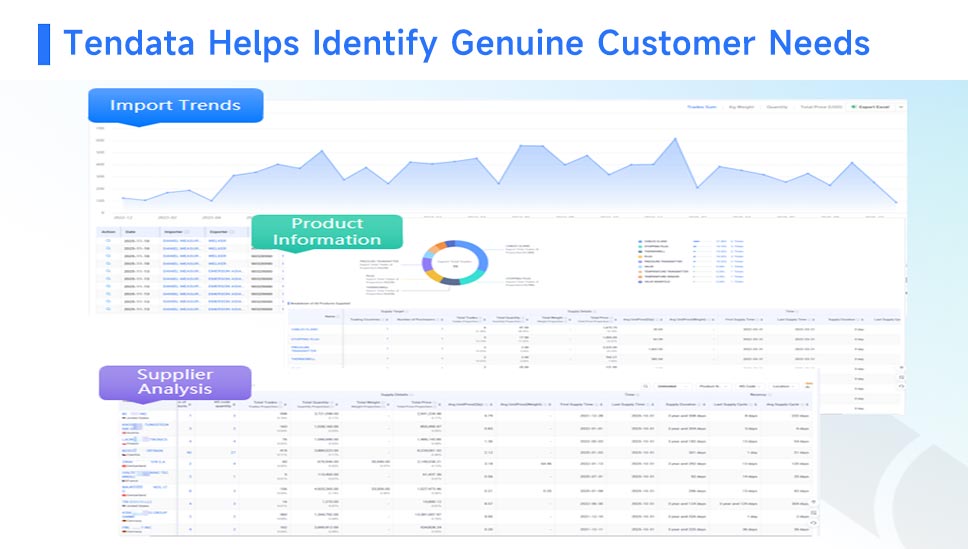
1. Conduct Background Checks Before Contacting Customers
By using Tendata iTrader, the company can investigate customer transaction records, purchased product names, supplier information, and other trade details before investing time in outreach.
This allows sales teams to better understand whether a prospect has genuine purchasing activity.
2. Connect With Decision-Makers More Efficiently
Tendata can provide social media contact information that helps sales teams connect with relevant decision-makers instead of relying only on generic company email addresses.
This can improve the efficiency of customer communication and increase the possibility of receiving meaningful responses.
3. Analyze Markets and Competitors
By analyzing export markets, new suppliers, and peer order situations through Tendata, the company can better understand market dynamics and competitors.
This supports the development of more targeted market strategies and product positioning.
Key takeaway: Instead of simply collecting more leads, companies can use world import export data to determine which prospects are more likely to have genuine purchasing needs.
Case 2: Weifang Yinuo Machinery Fittings Co., Ltd.
Using Trade Data to Move From Domestic Competition to Global Growth
Weifang Yinuo Machinery Fittings Co., Ltd. specializes in the development, creation, casting, production, and painting of ductile iron grooved pipe fittings.
The company faced increasing competition in the domestic market and needed to identify new growth opportunities overseas.
>>> Get a Free Demo from Tendata <<<
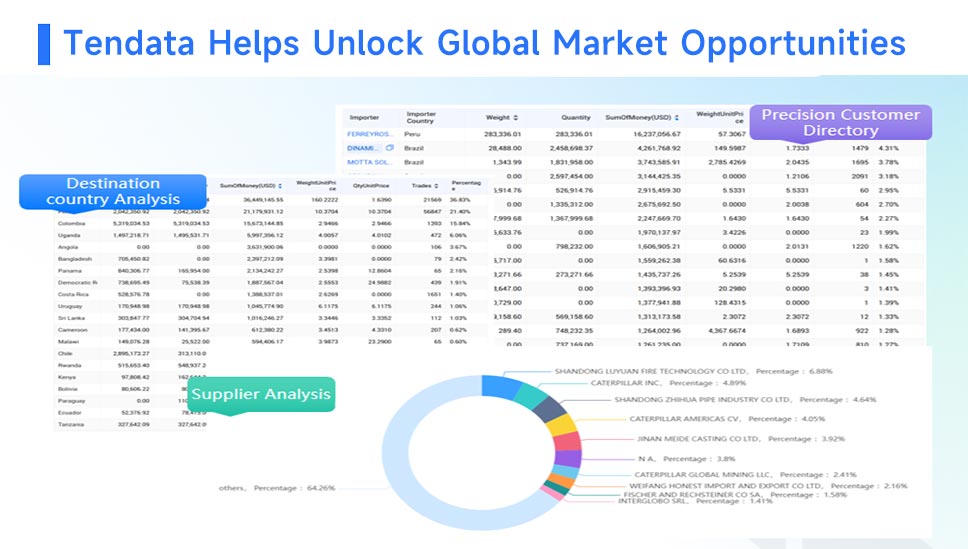
1. Identify High-Potential Overseas Markets
By analyzing global procurement trends through Tendata iTrader, the company can identify regional markets with strong demand and discover high-potential market opportunities.
Instead of entering overseas markets blindly, the company can prioritize markets according to actual procurement activity.
2. Build a More Precise Customer Acquisition Model
Traditional exhibitions often involve high customer acquisition costs and uncertain conversion rates.
Tendata helps identify highly matched prospects and combine them with targeted digital outreach methods such as personalized email campaigns.
This creates a more sustainable customer acquisition process.
3. Personalize Customer Communication
By analyzing customers’ historical purchase categories, purchase frequency, and supplier relationships, the sales team can understand customer behavior before sending an email.
Customized email content and product recommendations can then be developed based on actual purchasing patterns.
Key takeaway: World import export data becomes much more valuable when companies use it not only to identify countries but also to understand individual customer purchasing behavior.
Case 3: Shanghai Yicheng Packaging Products Co., Ltd.
Using Trade Data to Improve Product Expansion and Customer Trust
Shanghai Yicheng Packaging Products Co., Ltd. integrates design, production, printing, and post-production processes and specializes in packaging materials and related products.
The company wanted to expand overseas but faced difficulties identifying suitable high-value customers and establishing trust during the early stages of international business development.
>>> Get a Free Demo from Tendata <<<
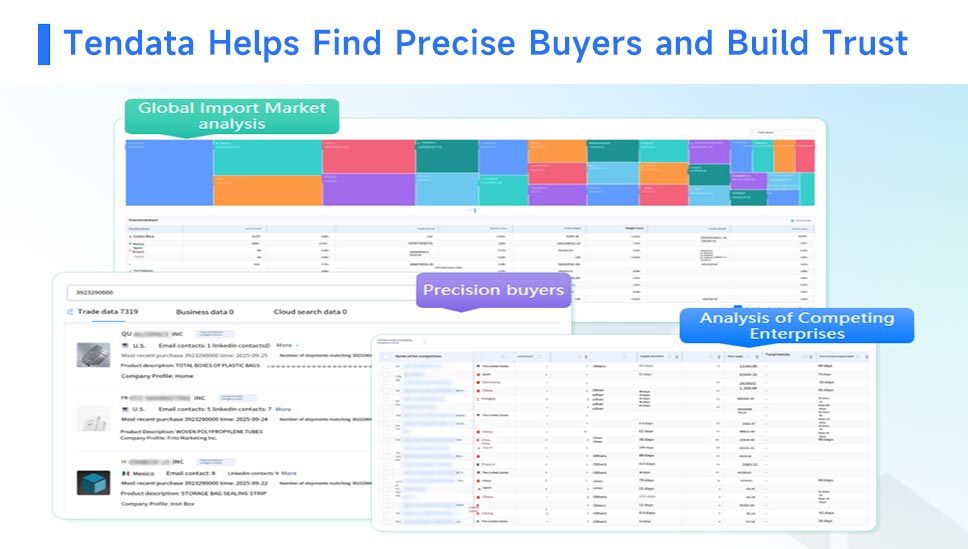
1. Identify Overseas Brand Customers With Real Demand
Using Tendata iTrader, the company can analyze global import markets and identify overseas brand merchants with relevant purchasing needs.
This allows sales teams to focus their resources on prospects with stronger product-market relevance.
2. Provide More Targeted Customer Guidance
For companies that are new to foreign trade data platforms, understanding how to use the available functions can be challenging.
Tendata helps customer managers provide personalized guidance based on users’ specific needs, helping them use iTrader functions more efficiently and accelerate the customer development process.
3. Improve Product Recommendations Through Historical Data
By analyzing customers’ historical transactions, Tendata can help businesses better understand customer preferences and recommend relevant products during communication.
This can support more professional customer conversations, strengthen trust, and improve the potential for high-quality business cooperation.
Key takeaway: Data is not only useful for finding customers. It can also help sales teams demonstrate greater professionalism by understanding a prospect before starting the conversation.
Final Thoughts
World import export data has become an important resource for companies looking to expand internationally. Free platforms such as UN Comtrade, ITC Trade Map, USITC DataWeb, Eurostat Comext, WITS, WTO Tariff & Trade Data, OEC, Japan Customs, India TradeStat, and Korea Customs Service provide valuable information for understanding global trade flows, product demand, tariffs, and market trends.
However, market statistics are only the beginning.
The real commercial value comes from connecting market intelligence with customer discovery. By analyzing purchasing behavior, supplier relationships, transaction history, and decision-maker information, businesses can move from broad market research toward more precise customer acquisition.
The three Tendata customer cases demonstrate this progression clearly: identify the right market, find the right customers, understand their real needs, and build more relevant communication.
For companies that want to turn world import export data into actionable sales opportunities, Tendata provides a more practical bridge between trade intelligence and customer development.
Start with the market. Follow the data. Find the right buyers. Turn trade intelligence into growth with Tendata.
Category
Leave Message for Demo Request or Questions