 Exhibition
 B2B Platforms
 Standalone Website
 Social Media
 Emails
Reading Export Import Data Before Making Your Next Global Trade Move - Tendata
 Trade Data Provider
 2026-08-13
International trade decisions are often made with incomplete information. A company may know that a product is selling well overseas, but that does not necessarily mean every market is worth entering. Demand, competition, purchasing behavior, and supplier relationships can vary significantly from one country to another.
This is why export import data has become an important resource for manufacturers, exporters, sourcing companies, and international sales teams. By examining how products move between countries, businesses can better understand market demand, identify emerging opportunities, and determine where their next customers may come from.
Rather than using trade statistics simply to measure import and export volumes, companies can use export import data to compare markets, study purchasing trends, understand competitors, and identify businesses that are already buying products similar to their own.

What Export Import Data Actually Shows
Export import data records the movement of goods between countries and regions. Depending on the database, it may include product descriptions, HS codes, trade values, quantities, origin and destination countries, and historical trade activity.
At a basic level, this information shows which countries are buying particular products and where those products are coming from. Looking at the data over time can also reveal whether demand is growing, declining, or shifting between markets.
For example, a manufacturer selling industrial components may discover that its traditional market has remained relatively stable while imports of the same product are increasing in several emerging economies. This could provide a reason to investigate those markets further.
Trade data can also help businesses compare markets before committing sales and marketing resources. Instead of asking only whether a country imports a product, companies can examine import value, growth trends, supplier concentration, and purchasing activity to determine whether a market deserves further attention.
10 Free Platforms to Research Export Import Data
Businesses do not always need a paid database to begin international market research. Many government statistical agencies provide free trade information that can help companies understand national import and export activity.
The following platforms offer useful resources for researching export import data:
1. Germany GENESIS-Online
Website: https://genesis.destatis.de/
Germany's Federal Statistical Office provides foreign trade data through GENESIS-Online. Users can explore German imports and exports by period, country, and product, with datasets available at detailed commodity levels.
2. France INSEE
Website: https://www.insee.fr/
France's National Institute of Statistics and Economic Studies publishes trade statistics covering imports and exports by product. The database also provides downloadable datasets for further analysis.
3. Ireland Central Statistics Office
Website: https://www.cso.ie/
Ireland's CSO publishes detailed trade statistics covering imports, exports, products, and trading partners. It can be useful for businesses researching Ireland's international trade structure.
4. Australian Bureau of Statistics
Website: https://www.abs.gov.au/
The Australian Bureau of Statistics provides international merchandise trade statistics based primarily on customs declarations. Data includes imports, exports, partner countries, and commodity information, with downloadable datasets available.
5. Singapore Department of Statistics
Website: https://www.singstat.gov.sg/
Singapore's official statistics system provides economic and trade indicators that can be used to research the country's international merchandise trade and relationships with global markets.
6. Italy Istat
Website: https://www.istat.it/
Italy's National Institute of Statistics provides foreign trade statistics covering Italian imports and exports. The data can be used to examine trade by products and partner countries.
7. Spain DataComex
Website: https://datacomex.comercio.es/
DataComex provides Spanish foreign trade statistics and allows users to explore import and export activity by products, countries, and other trade classifications.
8. Belgium Statbel
Website: https://statbel.fgov.be/
Statbel, Belgium's official statistics office, publishes foreign trade information covering imports, exports, products, and trading partners.
9. Poland Statistics
Website: https://stat.gov.pl/
Statistics Poland provides official economic and international trade statistics that can be used to examine Poland's import and export activities.
10. Czech Statistical Office
Website: https://csu.gov.cz/
The Czech Statistical Office provides foreign trade statistics and economic datasets covering the country's international trade activities.
These resources are particularly useful for initial market research. However, most official databases focus on aggregated trade statistics. Businesses looking for specific companies, purchasing histories, or contact information may need a more specialized source.
Where Free Trade Data Often Falls Short
Free databases are a useful starting point, but they are not always designed for customer acquisition.
A statistical database might show that a country imported a significant amount of a certain product last year. However, it may not tell a sales team which companies were actively purchasing that product, who the decision-makers are, or how those companies can be reached.
For customer development, businesses often need to answer additional questions:
- Who are the active buyers?
- What products are they purchasing?
- How frequently are they purchasing?
- Who are their existing suppliers?
- Has their purchasing activity increased or changed?
- Who are the key decision-makers?
- What communication channels can be used to reach them?
This is where trade data can become more valuable when combined with company intelligence, purchasing behavior, and social media information.
How Tendata Turns Export Import Data Into More Precise Customer Development
Tendatahelps businesses move beyond basic trade statistics by connecting export import data with customer purchasing behavior, company information, decision-maker contacts, and social media outreach. This makes it easier to move from identifying market opportunities to finding and engaging the right customers.
Identify High-Value Customers and Understand Their Purchasing Needs
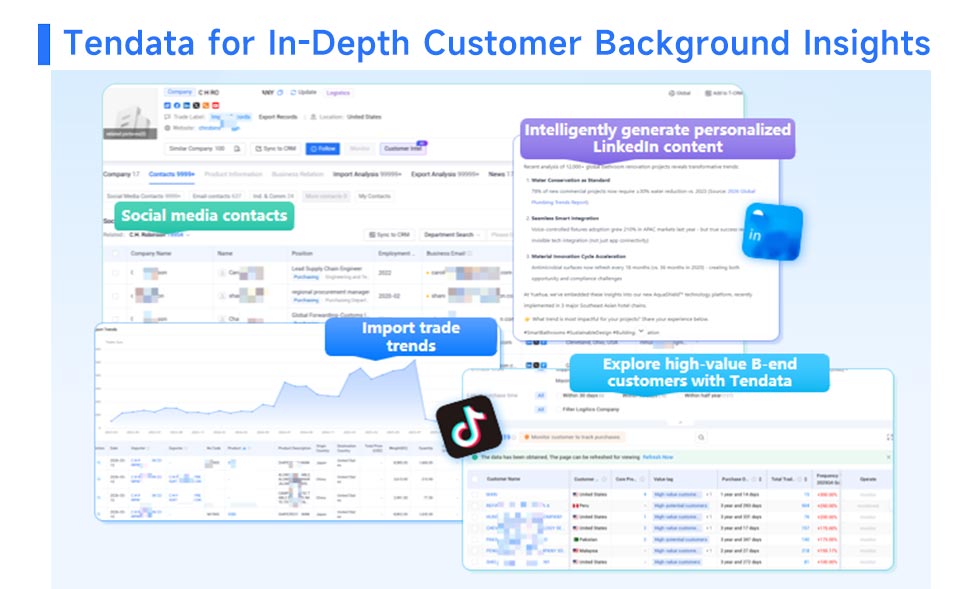
Tendata helps businesses discover high-value B2B customers through actual trade activity. By analyzing import and export records, purchasing trends, products, suppliers, and customer history, sales teams can identify companies with relevant purchasing activity and better understand their potential needs.
Tendata's T-Insight can further analyze the purchasing pain points and demand preferences of target customer groups. This allows businesses to create more precise customer profiles and develop communication based on actual purchasing behavior rather than general assumptions.
For example, businesses can explore customers with significant procurement activity in target markets, review their purchased products and supplier relationships, and conduct background checks before starting a conversation. This helps sales teams prioritize more promising prospects and prepare for more relevant business discussions.
>>> Get a Free Demo from Tendata <<<
Reach Decision-Makers Through Social Media and Personalize Follow-Up
Finding the right company is only the first step. Businesses also need to reach the right people inside those companies.
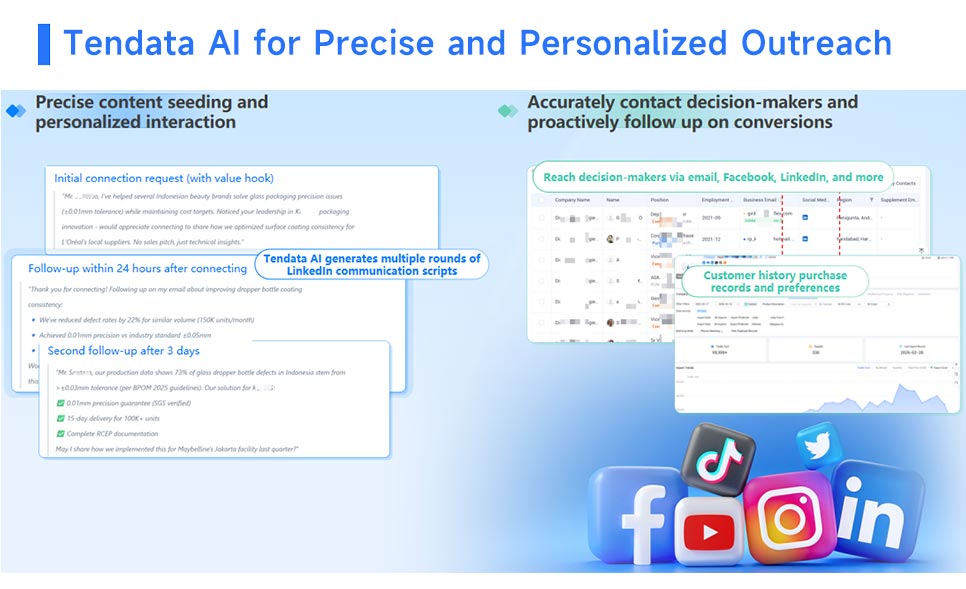
Through Tendata Trader V6.0, users can discover social media accounts associated with decision-makers and purchasing managers of target companies. This helps sales teams find relevant contacts on platforms such as LinkedIn and move from passively waiting for potential customers to actively identifying precise prospects.
Tendata AI can then generate personalized social media content and multiple rounds of LinkedIn communication scripts based on the characteristics and needs of different prospects. Combined with customer purchasing preferences and historical trade information, sales teams can make their outreach more relevant and follow up with greater precision.
This creates a more complete customer development process: identify high-value customers, understand their purchasing needs, find the right decision-makers, and engage them with personalized communication.
>>> Get a Free Demo from Tendata <<<
A Practical Example of Social Media and Trade Data Working Together
A case involving Foshan Gaoming Yuehua Sanitary Ware Co., Ltd. illustrates how social media and trade intelligence can work together.
The company had established multiple social media channels, but one challenge was that many potential customers were passively waiting for suitable content rather than being actively identified and approached.
The solution was to combine social media content with customer demand and historical trade records. By using trade data to understand purchasing activity and customer requirements, the company could create more targeted communication scenarios and strengthen customer engagement.
The company also used trade information to identify B2B customers with larger procurement activity in European and American markets. Customer background information, supplier details, purchased products, and other relevant data could then be combined to support more targeted customer development and face-to-face business opportunities.
The case demonstrates a broader point: social media becomes more powerful when it is connected to actual customer and trade intelligence rather than being used only for general content distribution.
Turning Trade Statistics Into Commercial Decisions
Free sources can provide a useful foundation for researching export import data. Official databases allow businesses to understand trade flows, compare markets, and identify broad changes in demand without immediately investing in a paid platform.
But market-level statistics are only part of the process.
The real commercial value comes from connecting those statistics with the companies behind the transactions. Businesses can start with questions such as:
Where is demand growing?
Then move to:
Which companies are driving that demand?
And finally:
Who should we contact, what do they need, and how should we approach them?
This is where a combination of trade data, customer purchasing behavior, company background information, decision-maker contacts, and social media engagement can make international sales research more actionable.
For companies looking beyond basic import and export statistics, Tendata provides a way to connect global trade activity with real businesses, purchasing trends, decision-makers, and customer development opportunities.
The goal is not simply to collect more export import data. It is to turn that information into better market decisions, more relevant prospects, more personalized outreach, and more focused international sales efforts.
Category
Leave Message for Demo Request or Questions