 Exhibition
 B2B Platforms
 Standalone Website
 Social Media
 Emails
The Data Behind a More Competitive Export Import Business - Tendata
 Trade Data Provider
 2026-08-14
Running an export import business involves much more than moving products from one country to another. Companies need to identify the right buyers, understand purchasing behavior, reach decision-makers, and maintain relationships after the first contact.
For many exporters and trading companies, customer acquisition remains one of the biggest challenges in international business. Sending large numbers of generic emails may generate little response, while relying only on exhibitions or online inquiries can make sales pipelines unpredictable.
Trade data provides another way to approach the problem. By studying actual import and export activities, companies can understand which businesses are purchasing products, where demand is concentrated, and when a potential customer may be worth approaching.
The challenge is turning this information into practical sales actions.

What Export Import Business Data Can Tell You
Export import business activities generate a large amount of information about products, countries, buyers, suppliers, and purchasing patterns.
Depending on the source, trade data may include HS codes, product descriptions, shipment values, quantities, importing and exporting countries, transaction dates, and other details.
For an exporter, this information can help answer questions that are difficult to answer through traditional market research.
Which companies are already buying similar products? Which markets have consistent demand? Who are the major suppliers? How frequently does a potential buyer purchase? Has its purchasing activity changed recently?
Looking at these patterns can help companies move away from broad prospecting and focus on businesses that have demonstrated actual purchasing activity.
10 Free Platforms to Research Export Import Business Data
Free government and statistical databases can be a useful starting point for companies researching international trade. Most provide aggregated trade statistics rather than complete company-level sales intelligence, but they can still help businesses understand markets, trade flows, and product demand.
Here are ten additional free platforms that have not been included in the previous lists.
1. Ghana International Trade Statistics
Website: https://statsbank.statsghana.gov.gh/
Ghana's official statistics portal provides international merchandise trade data that can be analyzed by year, month, trade flow, product classification, and partner country. The data is sourced from the Customs Division of the Ghana Revenue Authority.
2. Kenya National Bureau of Statistics
Website: https://www.knbs.or.ke/
Kenya's official statistics agency provides economic and international trade information covering imports, exports, trading partners, and other trade indicators. It can be used as a starting point for researching Kenya's position in regional and international markets.
3. Tanzania National Bureau of Statistics
Website: https://www.nbs.go.tz/
The Tanzania National Bureau of Statistics provides trade and transport statistics that can help businesses understand Tanzania's international trade activities, major products, and trade flows.
4. Statistics Botswana
Website: https://www.statsbots.org.bw/sector/merchandise-trade-statistics
Statistics Botswana publishes merchandise trade statistics covering imports, exports, major commodity groups, trade direction, and trading partners. The data can provide useful background for companies evaluating the Botswana market.
5. Rwanda National Institute of Statistics
Website: https://statistics.gov.rw/
Rwanda's National Institute of Statistics publishes formal external trade information covering imports, exports, re-exports, commodities, and trading partners. The information can be used to understand the country's changing trade structure.
6. Saudi Arabia General Authority for Statistics
Website: https://stats.gov.sa/
Saudi Arabia's official statistics platform provides international merchandise trade information covering imports and exports by goods, countries, and other trade classifications.
For companies exploring the Middle East, this type of data can provide a useful starting point for understanding Saudi Arabia's international trade activity.
7. Abu Dhabi Customs Foreign Trade Statistics
Website: https://www.adcustoms.gov.ae/en/Foreign-Trade-Statistics
Abu Dhabi Customs provides foreign trade statistics through its official platform, including monthly and annual information that can be used to research import and export activity in the region.
8. Morocco Foreign Trade Database
Website: https://services.oc.gov.ma/DataBase/CommerceExterieur/login
Morocco's Office des Changes provides an interactive foreign trade database. Users can research monthly import and export statistics and select different analysis dimensions and indicators. Results can also be exported in CSV format.
9. Costa Rica Ministry of Foreign Trade
Website: https://www.comex.go.cr/estad%C3%ADsticas-y-estudios/comercio-bienes/
Costa Rica's Ministry of Foreign Trade provides merchandise trade statistics covering imports, exports, and trade flows. Its statistics include historical trade information and data covering relationships with a range of international markets.
10. Peru SUNAT Foreign Trade Statistics
Website: https://www.sunat.gob.pe/estad-comExt/modelo_web/web_estadistica.htm
Peru's tax and customs authority provides foreign trade statistics and historical trade information. The platform includes import and export data organized by products, countries, sectors, and other classifications.
These free resources can give an export import business a useful starting point for researching market size, trade flows, product demand, and country-level opportunities.
However, companies focused on customer acquisition often need information beyond aggregated statistics.
Why Trade Statistics Alone May Not Be Enough
Knowing that a country imports large quantities of a product does not automatically tell an exporter which companies should be contacted.
For example, a company may discover that demand for a particular industrial product is growing in Saudi Arabia. The next questions are more commercial:
- Which companies are buying it?
- How often do they purchase?
- Which suppliers are currently serving them?
- Who should the sales team contact?
These questions require a more detailed view of the businesses behind the trade data.
This is where trade intelligence can become more useful for an export import business. Instead of simply identifying a growing market, companies can investigate potential customers and build a more targeted approach to outreach.
How Tendata Helps an Export Import Business Improve Customer Acquisition
Tendatacombines global trade data with business information, contact resources, and AI-powered tools to support international customer development.
Rather than relying on mass outreach, businesses can use actual trade activity to identify relevant prospects and then use customer information and AI tools to make communication more targeted.
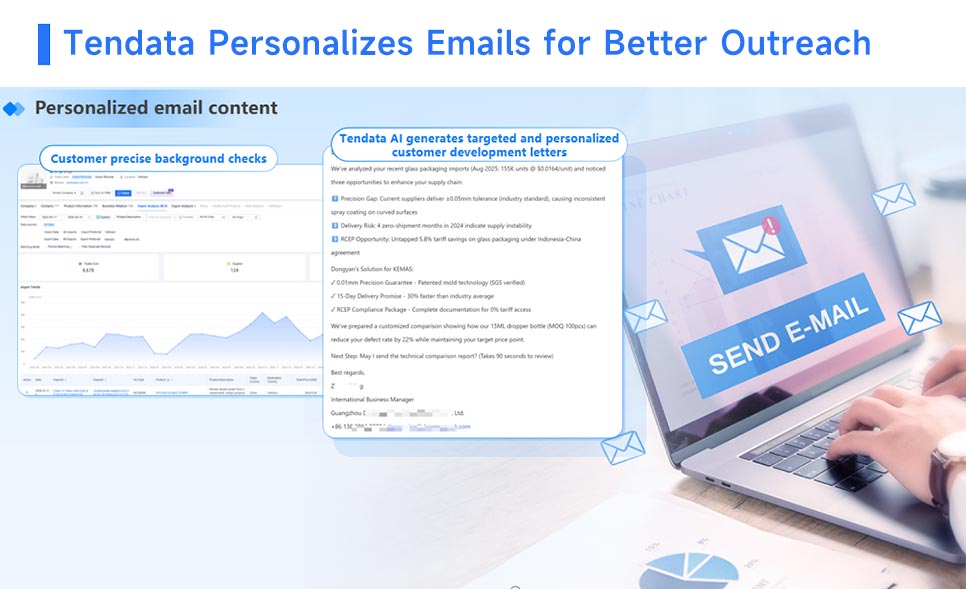
Create Personalized Email Content for Better Outreach
Generic email campaigns often struggle to get attention because the same message is sent to companies with very different products, purchasing patterns, and business needs.
Tendata combines customer and trade information with AI-powered content generation to help create more personalized email messages.
Sales teams can use relevant product, purchasing, and company insights when preparing outreach, making each message more specific instead of sending the same content to every prospect.
For an export import business, this creates a more targeted email marketing process based on actual customer characteristics and trade activity.
>>> Get a Free Demo from Tendata <<<
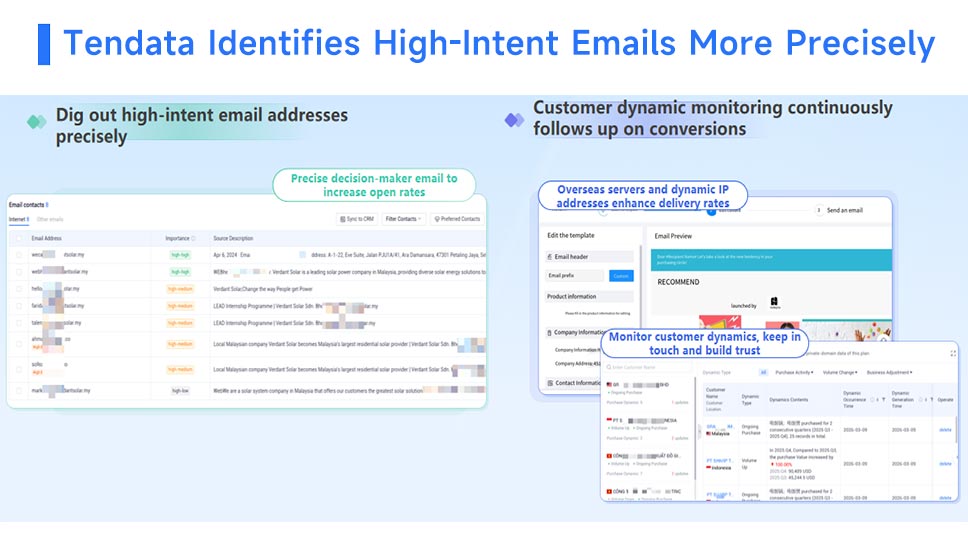
Identify High-Intent Email Addresses More Precisely
Finding the right customer is only useful if a business can reach the right person.
Tendata combines trade intelligence with available business contact information to help users identify relevant email addresses and other contact resources.
Sales teams can first narrow down prospects according to purchasing activity and then identify suitable contact information instead of collecting large numbers of unrelated addresses.
This helps reduce time spent on broad contact searches and allows sales teams to focus more on prospects with demonstrated purchasing activity.
>>> Get a Free Demo from Tendata <<<
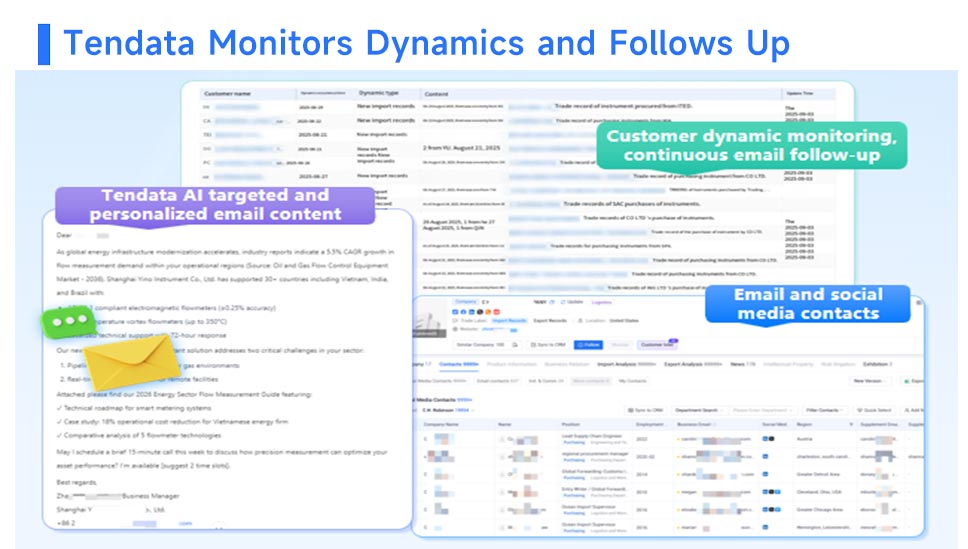
Monitor Customer Dynamics and Follow Up Continuously
Customer development does not end after an email is sent.
Purchasing behavior can change over time. A company may increase its import volume, start buying a new product, change suppliers, or become active in a different market. These changes can provide useful signals for sales teams.
Tendata helps businesses monitor customer purchasing dynamics and identify changes in trade activity, allowing sales teams to respond when new opportunities appear.
Instead of treating email outreach as a one-time campaign, an export import business can use ongoing purchasing signals to determine when a customer may need another conversation, a new product recommendation, or a more relevant follow-up.
>>> Get a Free Demo from Tendata <<<
A More Practical Approach to International Customer Development
For an export import business, the challenge is rarely a complete lack of data. The bigger challenge is connecting different types of information and turning them into useful sales actions.
Free trade databases can provide a solid foundation for understanding markets and international trade flows. But when businesses need to move from market research to customer acquisition, they need a deeper view of individual companies and their purchasing behavior.
Tendata connects trade activity, customer information, contact resources, and AI-powered marketing support in one workflow. This allows businesses to identify relevant prospects, prepare more personalized outreach, and continue monitoring customer activity after the initial contact.
The result is a more focused approach to international sales: find the right companies, understand what they are buying, reach them with relevant content, and follow up when new purchasing signals appear.
For companies building an export import business, better use of trade intelligence can turn customer acquisition from broad outreach into a more precise and repeatable process.
Category
Leave Message for Demo Request or Questions